

 1 hr 1 min
Why Building Muscle Is Key to Aging Well After 40
With JJ Virgin
126 episodes
From Nikkiey Stott and the WarriorBabe coaching team · Updated Oct 25, 2026
You may be doing everything you were told would work: classes most days of the week, light dumbbells, long workouts, maybe a new program every few weeks to keep things interesting. And your body still isn't changing the way you hoped. On The WarriorBabe Show, Nikkiey Stott's answer is direct. The problem usually isn't your effort or your age. It's that the training you're doing doesn't give your body a reason to build muscle.
1 hr 1 minWith JJ Virgin
 30 min
Episode 281 · Aug 1, 2025
 31 min
Episode 64 · Jun 5, 2023
 39 min
Episode 141 · Mar 25, 2024
 28 min
Episode 356 · Apr 27, 2026
The show's core point of view is that strength training after 40 is not optional. In Why Women Over 40 Are Losing Muscle and How to Stop It, Nikkiey explains sarcopenia, the age-related muscle loss she describes as starting in your 30s and speeding up in your 40s and 50s. She draws on her years in emergency rooms and long-term care to show what that loss looks like over time. In Why Women Over 40 Need Strength Training, she connects muscle to your metabolism, bone density, insulin sensitivity and everyday independence. JJ Virgin makes a similar case in Why Building Muscle Is Key to Aging Well After 40, calling muscle the real currency of aging well. Toned, as Nikkiey puts it again and again, is simply muscle plus low enough body fat for that muscle to show. You can't tone a muscle you haven't built.
The episodes are just as clear about what falls short. In Can Reformer Pilates Build Muscle After 40?, Nikkiey explains that Pilates and reformer classes have real value for mobility, body awareness and enjoyment, but spring resistance and body weight don't create the mechanical tension muscle growth requires. Keep the classes you love, just don't let them be your only resistance training. In How Often Should You Change Your Workout Routine?, she explains why program-hopping keeps you stuck in the learning phase with no baseline to measure progress, and why your workouts probably need to be more boring than you want. And in How Long Should Workouts Be for Women Over 40?, she makes the case that a focused 45 to 60 minute session beats the two-hour grind.
What works instead is consistent, progressive training. Across the show, Nikkiey recommends three to four days a week of strength work built on compound lifts, with progressive overload as the North Star: gradually adding weight, reps, sets or time under tension so your muscles keep adapting. Progressive Overload for Women: What It Is and How to Do It walks through the practical tools, and Full Body Workouts vs Bro Splits shows what her own sessions look like.
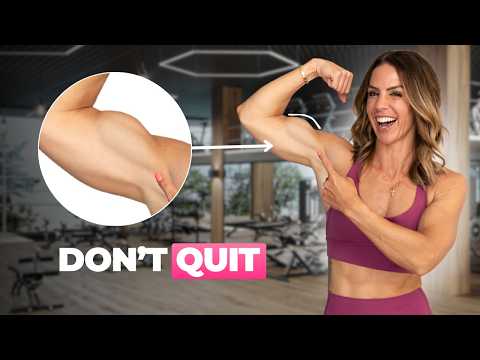
If you're new, start with Why Women Over 40 Need Strength Training for the why, then Why Am I Lifting Weights But Not Seeing Muscle? for the four things visible muscle requires: real tension, enough food and protein, recovery and progressive overload. If you've been lifting for a while and feel stuck, go to How Long Does It Take Women to Build Visible Muscle? and Not Seeing Results After 4 Weeks? Why You Shouldn't Quit. Building muscle takes months and years, not weeks, and the women in the member stories on this show, in their 50s, 60s and 70s, are proof that it is not too late to start.
Strength Training for Women
Three to four days a week is Nikkiey's core recommendation for women over 40: 30 to 45 minutes per session, built on compound lifts and progressive overload, with walking on off days and seven to eight hours of sleep. Lifting six or seven days a week, she says, breaks down muscle faster than you can rebuild it.
Read the answer →
Strength Training for Women
Not on their own. Nikkiey explains that F45, Orangetheory and CrossFit include strength work but don't prioritize muscle growth the way a progressive overload program does, because everyone in the room does the same workout. Keep the classes if you love them, but make them about 20% of your training and progressive lifting the other 80%.
Read the answer →

Strength Training for Women
Start by remembering that almost nobody is watching you. Nikkiey says most of the judgment lives in your own head. Then make it easier on yourself: learn the exercises on YouTube before you go, wear a hat as blinders, start small in a quiet corner, and walk into the weight room anyway, even scared.
Read the answer →
Strength Training for Women
No. Nikkiey explains that building significant muscle as a woman takes years of intentional, progressive heavy training plus eating in a calorie surplus. It does not happen from lifting three days a week. What you get instead is a leaner, more defined, stronger body that is more metabolically efficient.
Read the answer →

Strength Training for Women
Not in any meaningful way once you're past beginner level. Nikkiey explains that Pilates can help you maintain muscle and is great for mobility, flexibility and balance, but it can't grow new muscle the way strength training can. Building muscle takes progressive overload with dumbbells and barbells, and Pilates classes don't provide that kind of load.
Read the answer →

Strength Training for Women
Lift heavy enough that the last three reps of every set are challenging while your form stays good. Nikkiey says that if you finish a set thinking it was easy, the weight is too light. You don't need huge numbers. You need a weight that's hard for you, and you need to keep adding to it over time.
Read the answer →
 24 min
Episode 407 · Oct 23, 2026
 20 min
Episode 406 · Oct 19, 2026
 31 min
Episode 405 · Oct 16, 2026
 21 min
Episode 403 · Oct 9, 2026
 27 min
Episode 401 · Oct 2, 2026
 39 min
Episode 400 · Sep 28, 2026
 20 min
Episode 397 · Sep 18, 2026
 30 min
Episode 395 · Sep 11, 2026
 26 min
Episode 394 · Sep 7, 2026
 22 min
Episode 392 · Aug 31, 2026
 57 min
Episode 389 · Aug 21, 2026
 30 min
Episode 388 · Aug 17, 2026
Nikkiey Stott explains that significant muscle growth requires heavy weights, high training volume and a significant calorie surplus, and women have naturally lower testosterone than men. Most women training for fat loss or maintenance build definition rather than size, and as she puts it, bulk does not happen by accident.
According to the show, no. Nikkiey says Pilates and reformer classes are valuable for mobility, flexibility and body awareness, but spring resistance and body weight don't create enough mechanical tension to build muscle, so she recommends three to four days of progressive strength training with external load as the foundation and classes around it.
Nikkiey recommends 45 to 60 minutes, explaining that the 10 to 20 sets per muscle group per week she relies on fits into sessions of that length. She points to long warm-ups, phone-scrolling rest periods and too many exercises as the biggest time wasters.
Less often than you think. Nikkiey suggests keeping foundation movements in for six to eight weeks, treating lifts like squats and deadlifts as skills, and carrying forward exercises that are still progressing rather than starting over with a brand-new program.
Across the episodes, Nikkiey recommends three to four days a week of progressive strength training with compound lifts. If you're just starting, she suggests getting dumbbells in your hands two or three times a week, working in the 8 to 15 rep range with the last few reps challenging.
Nikkiey explains that the first weeks are mostly neurological, with visible changes often starting around weeks four to six and for some women not until day 90. Depending on where you start, she says the bigger payoff may come in six months, eight months or two years, which is why she asks women to commit to one program for a full year.