

The short answer
Two to four sessions a week, depending on who you ask on The WarriorBabe Show. Esther Blum and Dr. Stacy Sims put the minimum at two full-body sessions, with three to build more muscle and bone. Nikkiey suggests about four, or three, up to an hour each. Everyone agrees: not every day, because recovery builds muscle.
Hear it answered
Tap play to start right where it's answered. It keeps playing while you browse.
Esther Blum on why twice a week works and three isn't much different
Plays from 56:28 · Ep. 130: How to Navigate Menopause: Protein, Carbs, HRT and Lifting
Dr. Stacy Sims on two sessions for strength, three to build muscle and bone
Plays from 9:42 · Ep. 250: Why a 1200-Calorie Diet Fails Women Over 40
Nikkiey on why four sessions beats training hours every day
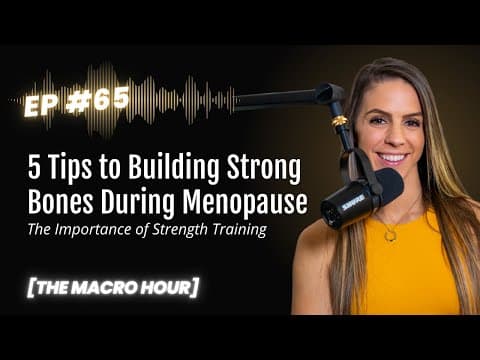
Plays from 16:59 · Ep. 65: Strength Training for Strong Bones During Menopause
Dr. Sims on whether lifting should change once you're in menopause
Plays from 6:14 · Ep. 250: Why a 1200-Calorie Diet Fails Women Over 40
The full answer
The guests set the floor. On Ep. 130, integrative dietitian Esther Blum says a minimum of twice a week will still get menopausal women results. You can do three or more if you feel great, but she says the science shows little clinical difference between women who lift twice a week and three times a week. On Eps. 250, 300 and 324, Dr. Stacy Sims gives a similar answer: two total-body compound sessions a week is the minimum for strength, and three if you want to accumulate more lean mass, meaning bone and muscle. If time is the problem, she says three 20-minute sessions can get a lot done.
Nikkiey goes a little higher. On Ep. 65 she recommends about four strength sessions a week, says you could even argue for three, and caps each session at about an hour. So the episodes differ on the upper number, but not on the principle.
That principle is recovery. Nikkiey explains that you break muscle down in the gym and build it in the hours and days after. Three hours a day, seven days a week, plus cardio is overtraining, and she says it's a recipe for wondering months later why all that work isn't paying off. Dr. Sims says plainly that you can't build without recovery, and Esther notes that menopausal women need more recovery time between sessions. She mentions hydration, enough carbs, creatine, glutamine, Epsom salt baths, saunas and cold plunges as ways to support it; check with your doctor before adding supplements.
If you've been training six days a week and getting nowhere, that's not a willpower problem. It's a plan built for a different phase of life. Fewer, harder, full-body sessions with real rest in between is what these episodes point to.
From WarriorBabe's coaches (how we write our answers). For education, not medical advice: talk to your doctor about your own health.
Women also ask
More on Strength Training for Women →
Strength Training for Women
Are weight machines as good as free weights for building muscle?
For building muscle, yes. One WarriorBabe coach says machines are not cheating and are one of the best tools for feeling your muscles work. She built most of her muscle in her first two years barely touching barbells. She still recommends a blend, because free weights build coordination, balance and core control that machines don't.
Read the answer →

Strength Training for Women
How do I get over gym anxiety?
Start by remembering that almost nobody is watching you. Nikkiey says most of the judgment lives in your own head. Then make it easier on yourself: learn the exercises on YouTube before you go, wear a hat as blinders, start small in a quiet corner, and walk into the weight room anyway, even scared.
Read the answer →

Strength Training for Women
How can I grow my glutes at home with dumbbells after 40?
Yes, you can grow your glutes at home with dumbbells after 40. Use loaded compound moves like Bulgarian split squats, glute bridges, Romanian deadlifts, step-ups and goblet squats. Train glutes at least twice a week, add weight or reps over time, and eat at least one gram of protein per pound of body weight.
Read the answer →

Strength Training for Women
What is the difference between exercising and training?
Exercise is any movement: walking, running, a class at your gym, or a fun workout you found on Instagram. Training has intention behind it. On The WarriorBabe Show, Nikkiey explains that training means working toward a specific adaptation, like building muscle, and measuring whether that adaptation is actually happening over time.
Read the answer →

Strength Training for Women
How often should I change my workout program?
Most of the time, run a program for four to eight weeks before changing it, and never less than four. Nikkiey's rule is to change for a reason, not because you're bored. Keep any lift that's still progressing, and don't run the same program unchanged for six months.
Read the answer →

Strength Training for Women
How many days a week should I lift weights?
Three to four days a week is Nikkiey's core recommendation for women over 40: 30 to 45 minutes per session, built on compound lifts and progressive overload, with walking on off days and seven to eight hours of sleep. Lifting six or seven days a week, she says, breaks down muscle faster than you can rebuild it.
Read the answer →
Watch or listen in full
More on this topic → 1 hr 3 min
Why a 1200-Calorie Diet Fails Women Over 40
With Dr. Stacy Sims
 1 hr 6 min
How to Navigate Menopause: Protein, Carbs, HRT and Lifting
With Esther Blum
 29 min
Strength Training for Strong Bones During Menopause
Episode 65 · Jun 7, 2023