

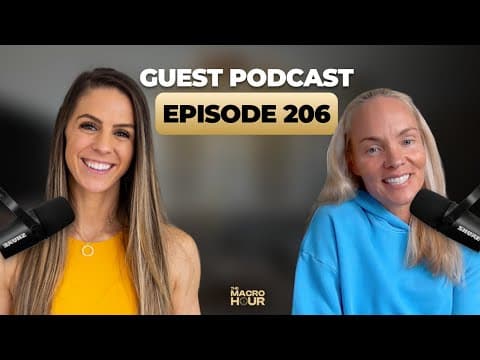
 48 min
Perimenopause, Hormone Testing and Strength Training at 50
With Janet Smith
Guest on the show
48 minWith Janet Smith
Janet Smith is a former second-grade teacher turned group fitness instructor and experienced registered yoga teacher. She just turned 50 and lifts heavy at least three days a week. Her path wasn't a straight line. Modeling, pageants and a daily weigh-in on an index card led to years of restriction, over-running and an eating disorder. That cost her muscle and her cycle, and she later had her gallbladder removed and struggled to conceive. What turned it around was curiosity: finding female mentors, learning that cardio isn't the only answer, treating food as fuel, and choosing to be stronger instead of thinner.
In this conversation with Nikkiey Stott, Janet explains the mindset shift that changed everything. She got rid of her scale for good, dropped her food rules, and moved from telling herself what she can't eat to choosing food for how it makes her feel. Then the conversation turns to perimenopause. She describes brain fog, mood swings, poor sleep and muscle that was harder to keep. A standard panel told her everything was fine. A full panel a year later showed her testosterone had tanked.
Janet shares her own experience with hormone replacement therapy: better sleep, muscle she had lost coming back, steadier mood and less dry skin. She is clear that what works is individual and should be worked out with the right provider. Nikkiey and Janet both urge women to advocate for themselves and not accept being told it's just the way it is. Janet's closing message is that it is never too late to take an hour a few days a week for yourself.

Menopause & Perimenopause Weight Loss
According to guests on The WarriorBabe Show, the first signs usually aren't hot flashes or missed periods. Dr. Jolene Brighten says falling progesterone shows up first as worsening PMS, irritability, breast tenderness and waking at night before your period, sometimes from 35. Hatty McCafferty adds sleep disruption, skin changes, digestive shifts and fatigue.
Read the answer →

Hormones & Hormone Health
Often because normal isn't the same as optimal. Nikkiey explains that standard lab ranges come from population averages wide enough to include about 95% of people, including those who are unhealthy, insulin resistant, sedentary or already symptomatic. Basic panels also tend to leave out key markers, like a full thyroid panel or testosterone.
Read the answer →
For Janet, the first signs were brain fog, forgetting things, uncharacteristic snappiness, a harder time falling and staying asleep, and finding it harder to put on and keep muscle. She says sleep patterns and mood are the changes women most often mention to her.
Janet's OBGYN ran the regular panel typical for women her age and told her everything was fine, but it didn't include testosterone. A full blood panel about a year later showed her testosterone had pretty much tanked, which she says is common for women her age and not typically tested.
Janet says she now gets eight hours of solid, uninterrupted sleep and was able to rebuild muscle she had lost over the previous five or so years. She also describes estrogen as a mood lifter and noticed less dry skin and better hair growth. She stresses this is her experience and that what works is individual.
She explains that pellets can't really be adjusted for about three months, and you have to lay off exercise after the insertion because of the incision. With the classes she teaches, she couldn't take that time off every three months.
Janet calls this the first myth women have to get over and says it's a lie that lifting will make you look like a male bodybuilder. Every class she teaches now includes strength training.
Janet says it is truly never too late, whatever age you are. Even an hour a few days a week, at home or at the gym, is a game changer and one of the best gifts you can give yourself.