The short answer
To lose fat after 40, eat enough rather than less. That means protein around one gram per pound of body weight, a small calorie deficit only when you're ready, strength training three to four days a week and daily walking. Nikkiey Stott's view is that your body isn't broken. It's responding to the inputs it gets, so change the plan, not your willpower.
What to know
- Nikkiey Stott explains that eating less and exercising more after 40 signals stress, so your body lowers its metabolic rate, raises cortisol, breaks down muscle and holds on to fat.
- When you do diet, keep the deficit small: about 10 to 20 percent below maintenance, and many women can lose fat at just 10 percent below.
- Nikkiey's protein target is about one gram per pound of body weight, so a 150-pound woman aims for roughly 150 grams a day, and that stays the same through menopause.
- Put fat loss in this order: nutrition first, strength training second and cardio as the cherry on top.
- Belly fat can't be spot-reduced with crunches; it comes off through a whole-body deficit, and the midsection often leans out last.
- Judge progress by waist measurements, progress photos, how your clothes fit and your strength, with the scale as supporting data rather than the decision maker.
On this page
- Why can't I lose weight after 40 when I eat less?
- Does menopause cause weight gain?
- Weight loss vs fat loss: body composition and skinny fat
- How many calories should I eat to lose weight?
- How to lose belly fat after 40, including menopause belly
- What to eat to lose weight after 40: protein first
- Best exercise for fat loss after 40: lift first, walk daily
- Weight loss plateau: what to do when the scale stops moving
- How to measure body fat and track progress
- More questions
Why can't I lose weight after 40 when I eat less?
Because eating less and doing more tells your body it's under stress. Nikkiey Stott explains that your body after 40 doesn't respond to restriction the way it did at 25. It lowers your metabolic rate, raises cortisol, breaks down muscle and holds on to fat.
Many women on The WarriorBabe Show describe the same pattern: around 1,100 to 1,300 calories a day, training five or six days a week, and ending up tired, softer and stuck. In Why Eating Less Isn't Helping You Lose Fat After 40, Nikkiey is clear that a calorie deficit is still required for fat loss. But cutting food every time progress slows makes you move less, train worse and struggle to stick to the plan.
When calories stay low for a long time, your everyday movement quietly drops, which shrinks the deficit you thought you had. Nikkiey also explains that in a long deficit your metabolism slows, hunger hormones shift and performance declines. A stall is your body adjusting, not proof that you failed.
Her bottom line: this is not a willpower problem, and your metabolism isn't broken. It has adapted, and what adapted can readapt. The question she wants you to ask is not how little you can eat, but how much you can eat while still making progress.
Does menopause cause weight gain?
Partly, according to the show, but it's rarely the whole story. On The WarriorBabe Show, the explanation is that as estrogen declines, fat storage shifts from the hips and thighs to the belly and around the organs, and muscle becomes easier to lose. Guests add that insulin and stress are major drivers, even when your eating and training stay the same.
Nikkiey, who is in perimenopause herself, describes the shifts she sees in this phase: estrogen declining and protecting muscle less, progesterone fluctuating and disrupting sleep, and insulin sensitivity decreasing. Lara Briden explains on the show how perimenopause pushes women toward insulin resistance.
Both things are true at once, Nikkiey says. Perimenopause is real and makes fat loss genuinely harder. But a significant portion of what women blame on it comes from a plan that was never going to work: too little protein, no progressive lifting, inconsistency, or hormones never actually tested.
Her advice is to run two tracks together. Get your hormones properly tested and have an informed conversation with your doctor, including about HRT. And rebuild your plan with more protein, real strength training and better sleep. As Dr. Jolene Brighten puts it, HRT alone is not enough without nutrition and lifestyle.
Weight loss vs fat loss: body composition and skinny fat
Weight loss is any drop on the scale; fat loss is losing body fat while keeping your muscle, and fat loss is the goal. Nikkiey explains that the scale counts fat, muscle, water, undigested food and even organs, so it can't tell you which one you lost.
Body composition is the proportion of fat, muscle and bone in your body. Building muscle while losing fat improves it and gives you a leaner, more toned look, even when the scale barely moves.
Chase weight loss alone with aggressive dieting and lots of cardio, and you lose muscle along with fat. That's how women end up what Nikkiey calls a skinnier, fatter version of themselves. She did it herself: she started around 140 pounds and skinny fat, and now weighs 145 to 150 pounds with a smaller waist, visible abs and stronger legs.
This is the idea behind body recomposition. Nikkiey explains that eating at maintenance while strength training lets many women over 40 build muscle and slowly lose fat at the same time, and some WarriorBabe clients have lost weight this way without ever doing a cut. If you have 30-plus pounds to lose, she says a cutting phase may fit better.
How many calories should I eat to lose weight?
Find your maintenance first, then eat only a little below it. Nikkiey recommends starting about 10 to 20 percent below maintenance, roughly 300 to 500 calories. Aggressive cuts speed up muscle loss, drain energy and trigger metabolic adaptation, so start small, keep protein high and keep lifting.
One WarriorBabe coach's starting point for maintenance is your body weight in pounds times 13 to 15, then eating 200 to 300 calories below it. For a 160-pound woman, that maintenance is roughly 2,100 to 2,400 calories. Nikkiey cautions that online calculators miss menopause, muscle mass and dieting history, so treat any number as a rough start and adjust to how your body responds.
Count your whole week, not just weekdays. Nikkiey explains that a modest weekday deficit adds up to about 2,000 calories, and one Saturday of brunch, drinks, dinner and dessert can eat back 2,000 to 3,000. Little bites and tastes add up too, sometimes 300 or 400 calories over a week.
If you've dieted for years, a cut may not be your first step. Nikkiey says signs you need a reverse diet include eating under 1,500 calories without losing weight, poor sleep, low energy, feeling cold or bingeing when you restrict. In Reverse Dieting for Women Over 40: Do You Need One?, she describes tracking about a week to find your baseline, then adding roughly 100 to 150 calories a week, protein first, holding each step for one to two weeks. On your own, she suggests a more conservative 50 to 100 a week.
How to lose belly fat after 40, including menopause belly
Build muscle and fix your nutrition instead of adding crunches, cardio or cutting food further. Nikkiey explains that belly fat can't be spot-reduced. It comes off through a calorie deficit across your whole body, and the midsection often leans out last.
Eating too little can make it worse. WarriorBabe's coaches say chronic under-eating, often 1,100 to 1,300 calories a day, signals famine to your body, which raises cortisol, slows metabolism and makes it hold on to belly fat. One coach explains that the usual fix of eating less and doing more cardio raises cortisol further, so the body holds on tighter. The priorities WarriorBabe teaches instead:
- Progressive strength training, the first lever for belly and visceral fat
- Enough protein at every meal
- Sleep and stress management
- Less alcohol: one coach explains your liver prioritizes clearing it, so fat burning stops for hours, and it disrupts sleep
- Daily walking, with short sprint intervals in place of long cardio
Track your waist, not just pounds. Nikkiey says strength training can reduce visceral fat even when your weight doesn't change. Many women see early changes within 30 days, like less bloating and clothes fitting better, while real fat loss and inches come over months to a year.
What to eat to lose weight after 40: protein first
Start with protein. Nikkiey's advice is to track what you actually eat for a week, find where you fall short, usually protein, and build meals around a daily protein target before you worry about carbs and fats.
Across episodes she gives a range of about 0.7 to 1 gram per pound of body weight, often recommending about one gram, so a 150-pound woman aims for roughly 150 grams. If you have a lot to lose, base it on a realistic goal weight. She suggests building up gradually, starting closer to 100 grams spread across your meals, and anchoring each meal around a complete protein like chicken, eggs, fish, Greek yogurt or cottage cheese.
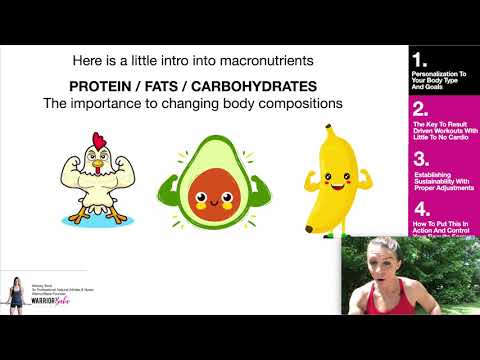
Look at macros, not just calories. Nikkiey explains that calories decide whether you lose or gain weight, while macros decide what your body actually looks like. Without enough protein, a deficit costs you muscle along with fat.
Carbs stay in. For perimenopause and menopause, Nikkiey explains that WarriorBabe lowers carbs moderately and raises fats, using a split of 35% protein, 27% carbs and 38% fat. It's not keto, and guest Louise Digby warns that going too low can slow your metabolism.
Best exercise for fat loss after 40: lift first, walk daily
Strength training beats cardio for fat loss, and nutrition comes before both. In Cardio, Weights or Diet: What Matters Most for Fat Loss?, Nikkiey calls nutrition the king, strength training the queen and cardio the cherry on top. Muscle keeps burning calories at rest, while cardio burns them only while you're doing it.
Her plan is progressive strength training three to four days a week, using compound movements like squats, deadlifts, rows and overhead presses. Increase the weight when the last two to three reps of a set stop feeling challenging. Dr. Stacy Sims makes the case on the show for heavy compound lifting with real rest between sets, because light weights with high reps stop producing change.
Walking does more than you'd think. Nikkiey recommends 8,000 to 12,000 steps a day, building up by 1,000 to 2,000 steps a week if you're well below that. She explains walking burns calories without spiking cortisol the way long or high-intensity cardio can, and a 10 to 15 minute walk after a big meal can help with bloating and blood sugar.
Cardio isn't bad, but it shouldn't be your main tool. Overdoing it, especially in a deficit, can cost you muscle and add to cortisol. If you're cutting back, Nikkiey suggests easing out: swap one cardio session a week for strength training, then swap a run for a walk.
Weight loss plateau: what to do when the scale stops moving
First check that it's a true plateau, then make one small change rather than a big cut. Nikkiey defines a plateau as weeks of consistent eating, tracking, training and sleep with no change in photos, scale or inches. One or two weeks without a drop isn't a plateau.
If it is real, she gives two options: ride it out for two to four weeks without changing anything, or make one small tweak, like trimming 100 to 150 calories from carbs and fat. Elsewhere she says to lower calories only after around eight weeks of honest tracking and consistent movement, and that sometimes a little more movement is the better adjustment.
Daily swings are neither plateaus nor fat gain. Nikkiey explains the scale reacts to carbs, sodium, your menstrual cycle, undigested food, stress, travel and muscles holding water after a hard workout. A two to three pound swing is normal, and it usually balances out in a day or two.
If you weigh in, do it in the morning after the bathroom and before food or water, under the same conditions each time, and watch weekly averages. Nikkiey suggests daily weigh-ins if you can stay neutral, or two to three times a week if the number triggers you. And if you've dieted for months and feel hungry, weak and exhausted, she says a maintenance phase may serve you better than another cut.
How to measure body fat and track progress
Use photos, a tape measure and your strength, with the scale as supporting data. Nikkiey says the body fat numbers on home scales are not accurate, though a consistent trend can still help. For a truer reading she points to an InBody or DEXA scan, and in What to Expect in a Cutting Phase: Hunger, Energy, Strength she adds that a handheld caliper is less accurate but useful if you stick with the same tool. What to track each week:
- Waist: once a week, same day and time, first thing in the morning after the bathroom
- Progress photos: about once a week, front, side and back in the same conditions
- Clothes: how they fit
- Strength: whether you're lifting more than two weeks ago
- Biofeedback: energy, sleep, hunger, digestion, mood, and performance and recovery
Non-scale victories count. Nikkiey lists consistency in your routine, measurements and photos, better mood, more energy, a renewed zest for life, and growing endurance and strength. In How Women Over 40 Lose Fat When the Scale Won't Move, she tells the story of Robin, a 60-year-old WarriorBabe who ate more, trained less and lost only four to five pounds in 14 months, while her friends thought she had lost 20 to 30.
Plan on months, not weeks. Nikkiey says sustainable fat loss might average 0.5 to 1 pound per week, with some weeks showing nothing. You'll often feel changes in the first four weeks before you see them, noticeable body composition change typically shows around 8 to 12 weeks, and lasting change can take six months to a year or more. It's the plan, not you, so give it time to work.
Written from what WarriorBabe's coaches and guests say in the episodes, videos and answers linked above (how we write our guides). For education, not medical advice: talk to your doctor about your own health.
More questions
Can you lose weight by eating more?
Yes, according to The WarriorBabe Show. Nikkiey says almost every WarriorBabe success story involves eating more, and members like Amy, Debbie, Lisa and Erin lost weight after raising their calories from chronic lows. The key is eating enough to fuel strength training and build muscle.
Is it possible to lose weight after menopause?
Yes. The show has featured several post-menopausal women who lost weight: Debra went from close to 180 to 149 pounds, Amy lost over 40 pounds and Bryn lost over 25 while eating more. Nikkiey explains the approach is enough food and protein, consistent strength training and patience.
Can a woman over 50 lose weight eating 2,000 calories a day?
The WarriorBabe Show says many women over 50 can see results eating close to 2,000 calories. Melissa, 58, eats about 1,900 a day while her clothes get looser and she sets gym personal bests, and Maggie went from aiming for 800 calories a day to eating almost triple that.
Why is it so hard to lose the last 10 pounds?
Nikkiey explains that as you get leaner, a smaller body burns fewer calories for the same activities, your metabolism slows and your body treats those pounds as a reserve. Her fix is consistent, dialed-in nutrition for 60 to 90 days, not more cardio.
How long should a fat loss phase last?
Nikkiey's general guideline is three to five months for a moderate fat loss phase if you're consistent, stretching to six to eight months if you have a lot to lose or keep falling off on weekends. Fat loss isn't meant to last forever.
Do I have to give up coffee to lose belly fat?
No. One WarriorBabe coach says the problem is what goes into it, since sugary lattes, frappuccinos and flavored creamers can pack 400-plus calories. She suggests black coffee or cold brew with a splash of unsweetened almond, oat or coconut milk.
Do vibration plates and waist trainers help you lose fat?
No. Maggie explains that vibration plates don't create enough tension to build muscle or drive fat loss, and waist trainers only make you sweat water that comes back when you drink. Dumbbells, protein and proper nutrition do the real work.