

From 1 episode and 4 videos
What exercises should a full body workout for women over 40 include?
Answered by Nikkiey Stott and her guests · Updated
The short answer
Nikkiey's full body workouts draw from joint-friendly staples: Smith machine or pendulum squats, hip thrusts, Romanian deadlifts, seated leg curls, rows, lat pulldowns or assisted pull-ups, incline presses, cable lateral raises, overhead tricep extensions and curls. Each session you pick one per muscle group, usually six or seven exercises, and push each one hard.
Hear Nikkiey answer it
Tap play to start right where it's answered. It keeps playing while you browse.
Nikkiey walks through her joint-friendly gym exercises, muscle group by muscle group
Plays from 2:24 · Video: Joint-Friendly Full Body Gym Workout for Women Over 40
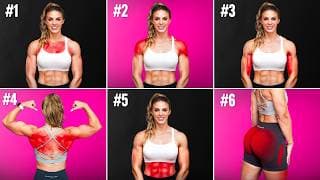
The order she trains muscle groups and why six to seven exercises is enough
Plays from 3:45 · Video: How to Structure a Full Body Workout in Menopause
On Ep. 64, what a full body training day actually looks like for Nikkiey
Plays from 28:23 · Ep. 64: Full Body Workouts vs Bro Splits: Which Is Better After 40?
A dumbbell version built around step-ups and exercises that spare the joints
Plays from 1:15 · Video: 6 Joint-Friendly Exercises to Build Muscle After 40

The weekly rules: one leg move a day, overload, warmups and accessory work
Plays from 6:32 · Video: Full Body Workout Routine for Women Over 40: 4-5 Days
The full answer
Nikkiey's structure is simple: one strong exercise per muscle group, in roughly this order: legs, glutes, back, chest, shoulders, then triceps and biceps. Abs get rotated in every other session rather than every day. She says the minimum is about five to seven movements, and with focus and tight rest periods the whole workout fits into 45 to 60 minutes. Because it's the only exercise that muscle gets that day, she goes all in and pushes close to failure instead of saving energy for four more moves on the same body part.
On Ep. 64, Nikkiey explains that she often opens with a compound lift such as squats, a chest press, a barbell row or an overhead barbell press, then works through the remaining muscle groups. Legs show up every day because they're a big muscle group that drives energy expenditure. In her 4-5 day routine video she adds a few non-negotiables:
- Progressive overload on compound lifts like deadlifts, squats and hip thrusts
- An intentional warmup, which she calls an injury prevention tax
- Accessory volume for shoulders, triceps and back, often lagging areas after 40
- Core and balance work to protect your spine and posture
The exact exercises depend on your setup. Her gym version leans on machines and cables chosen for joint support, like seated leg curls over lying ones and incline presses that are easier on the shoulders. Her joint-friendly dumbbell version swaps in step-ups instead of squats or lunges, dumbbell bench press instead of push-ups, inverted pull-ups to build toward full pull-ups, and dumbbell front raises.
If hammering one body part has left you too sore to show up, Nikkiey's point is that it's the program, not your consistency. Spreading the work across the week gives each muscle steady stimulus and real recovery.
From Nikkiey Stott and WarriorBabe's coaching. For education, not medical advice: talk to your doctor about your own health.
Women also ask
More questions →
Strength Training for Women
Are full body workouts better than body part splits for women over 40?
For most women over 40, Nikkiey Stott recommends full body workouts over body part splits. One exercise per muscle group, four to five days a week, spreads the work out so you recover between sessions and stay consistent. She's clear that bro splits aren't bad, though. Progressive overload is what matters most.
Read the answer →
Strength Training for Women
Are weight machines as good as free weights for building muscle?
For building muscle, yes. Nikkiey says machines are not cheating and are one of the best tools for feeling your muscles work. She built most of her muscle in her first two years barely touching barbells. She still recommends a blend, because free weights build coordination, balance and core control that machines don't.
Read the answer →
Strength Training for Women
How can I work up to doing a pull-up?
Work up to a pull-up in stages. Nikkiey recommends starting with inverted pull-ups until they feel comfortable, then jumping up to the bar and slowly lowering yourself (negatives), then banded or machine-assisted pull-ups, and finally full bodyweight pull-ups. Each stage builds the back, arm and core strength the next one needs.
Read the answer →
Watch or listen in full
More on this topic → 7 min
6 Joint-Friendly Exercises to Build Muscle After 40
Video · Sep 4, 2025
 31 min
Full Body Workouts vs Bro Splits: Which Is Better After 40?
Episode 64 · Jun 5, 2023
 17 min
How to Structure a Full Body Workout in Menopause
Video · Apr 25, 2026