

From 1 episode and 3 videos
Are weight machines as good as free weights for building muscle?
Answered by Nikkiey Stott and WarriorBabe's coaches · Updated
The short answer
For building muscle, yes. One WarriorBabe coach says machines are not cheating and are one of the best tools for feeling your muscles work. She built most of her muscle in her first two years barely touching barbells. She still recommends a blend, because free weights build coordination, balance and core control that machines don't.
Hear it answered
Tap play to start right where it's answered. It keeps playing while you browse.
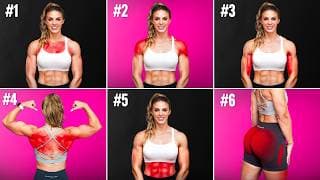
One WarriorBabe coach on building most of her muscle on machines and when to prioritize them
Plays from 7:34 · Video: How to Structure a Full Body Workout in Menopause
Why free weights still matter for balance, coordination and bones in menopause
Plays from 22:21 · Ep. 65: Strength Training for Strong Bones During Menopause
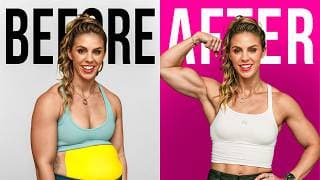
Why machines are a smart, joint-friendly choice for women over 40
Plays from 4:29 · Video: Joint-Friendly Full Body Gym Workout for Women Over 40
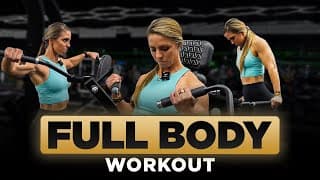
How machines stop you overcompensating, and why a blend of both works best
Plays from 26:51 · Video: Machine Leg Day Workout With Upper Body Supersets
The full answer
One WarriorBabe coach explains that the mind-muscle connection is the most important part of growing muscle, and machines make it easier. Because the machine handles stability, you're not worrying about balance or setup, so you can slow down and put your attention into the muscle itself. Machines also make it harder to overcompensate. On a dumbbell shoulder movement she tends to pull in her traps, but the machine isolates the shoulder so the right muscle does the work.
She leans on machines most when you are:
- learning a new movement
- trying to isolate a specific muscle
- working through an imbalance
- coming back from an injury
In her joint-friendly workout for women over 40, she adds that machines are a smart choice if you care about protecting your joints. But a machine only works if you use it properly. Her main cue is to slow the rep down and squeeze the muscle at the top so you feel exactly where the tension is. Her go-to machines are the leg press, seated row, leg curl, lat pulldown and leg extension.
The nuance comes on Ep. 65, which is about bone health in menopause. There Nikkiey says many women in their 50s and 60s gravitate to machines because they feel safer, but free weights, barbells and resistance bands offer a different kind of resistance and build coordination, ab control and balance. She suggests machines make up a percentage of your routine rather than all of it, and calls the Smith machine a good way to build form and confidence before moving under a barbell.
So it isn't machines versus free weights. If machines are where you can feel the muscle and train without pain, that's real progress. Add free weights over time for the strength, coordination and stability they bring.
From WarriorBabe's coaches (how we write our answers). For education, not medical advice: talk to your doctor about your own health.
Women also ask
More on Strength Training for Women →
Strength Training for Women
What exercises should a full body workout for women over 40 include?
WarriorBabe's full body workouts draw from joint-friendly staples: Smith machine or pendulum squats, hip thrusts, Romanian deadlifts, seated leg curls, rows, lat pulldowns or assisted pull-ups, incline presses, cable lateral raises, overhead tricep extensions and curls. Each session you pick one per muscle group, usually six or seven exercises, and push each one hard.
Read the answer →
Strength Training for Women
How do I fix a strength imbalance between my left and right side?
Train each side on its own. The fix is unilateral work. Start with your weaker side, using a weight it can handle that still challenges it. Then do the same weight and reps on your stronger side. The strong side will find it easy, and that's the point. It gives the weaker side room to catch up.
Read the answer →
Strength Training for Women
Are full body workouts better than body part splits for women over 40?
For most women over 40, Nikkiey Stott recommends full body workouts over body part splits. One exercise per muscle group, four to five days a week, spreads the work out so you recover between sessions and stay consistent. She's clear that bro splits aren't bad, though. Progressive overload is what matters most.
Read the answer →

Strength Training for Women
How often should women in menopause lift weights?
Two to four sessions a week, depending on who you ask on The WarriorBabe Show. Esther Blum and Dr. Stacy Sims put the minimum at two full-body sessions, with three to build more muscle and bone. Nikkiey suggests about four, or three, up to an hour each. Everyone agrees: not every day, because recovery builds muscle.
Read the answer →
Strength Training for Women
Should I do compound or isolation exercises first in my workout?
Do your compound exercises first. One WarriorBabe coach explains that tiring out smaller muscles with isolation work before the big lifts means you lift lighter and do fewer reps on the movements that build the most strength and muscle. Save isolation exercises for afterward, when they can target specific muscles and finish them off.
Read the answer →

Strength Training for Women
How many days a week should I lift weights?
Three to four days a week is Nikkiey's core recommendation for women over 40: 30 to 45 minutes per session, built on compound lifts and progressive overload, with walking on off days and seven to eight hours of sleep. Lifting six or seven days a week, she says, breaks down muscle faster than you can rebuild it.
Read the answer →
Watch or listen in full
More on this topic → 17 min
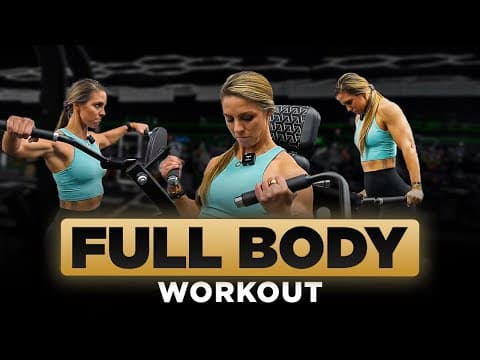
How to Structure a Full Body Workout in Menopause
Video · Apr 25, 2026
 34 min
Machine Leg Day Workout With Upper Body Supersets
Video · Feb 11, 2024
 29 min
Strength Training for Strong Bones During Menopause
Episode 65 · Jun 7, 2023