

From 4 videos
What should training to failure feel like?
Answered by Nikkiey Stott and WarriorBabe's coaches · Updated
The short answer
Training to failure should feel like you physically cannot complete another rep with control. One WarriorBabe coach describes it as the last rep or two of a set, when you can't pull, push or keep control of the movement. It shouldn't look pretty. If you can breeze through the set, the weight is too light.
Hear it answered
Tap play to start right where it's answered. It keeps playing while you browse.

A WarriorBabe coach describes exactly what the point of failure should feel like
Plays from 2:46 · Video: Gym Back Workout for Women: Cable Rows, Pulldowns and Flys

Why the last two to three reps of every set should feel challenging
Plays from 8:32 · Video: Best Macros for Menopause Belly Fat: A 32/30/38 Split

Nikkiey on why a hard set should never look pretty
Plays from 14:13 · Video: Gym Shoulder Workout for Women: Lateral Delts and Chest

Her mental trick for finishing a max-rep set: counting in twos
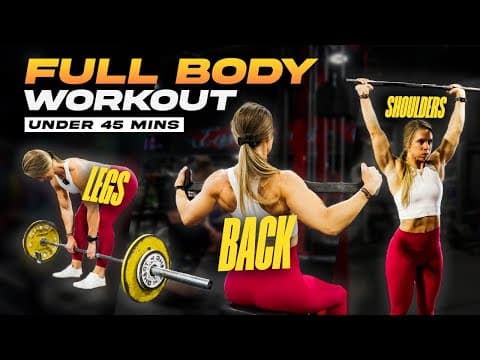
Plays from 4:31 · Video: 45-Minute Full Body Gym Workout: Bench, RDL, Lat Pulldown
The full answer
On her back workout video, one WarriorBabe coach programs cable pulldowns for three sets to failure. She explains that you know you've reached failure when you're at the last rep or two and you physically feel like you cannot pull, push or maintain control of the rep. The word that matters is control. In her shoulder workout Nikkiey points out a common mistake: when the weight is too heavy, people arch their back to force it up. Her fix is to press your back against the seat and lower the weight so you keep good form. Failure is where clean reps stop. It is not the point where you start cheating.
For regular sets that aren't taken to failure, one WarriorBabe coach still sets a clear standard. In the menopause macros video she says the last two to three reps of every set should feel challenging to push through. She pairs that with progressive overload, gradually making workouts harder with more sets or reps, adjusting your rest, and adding drop sets, so your muscles have a reason to keep adapting. Her point is blunt: stop going through the motions and put intention into each workout.
How it looks matters too. Nikkiey says there should be nothing pretty about your sets. If you aren't making facial expressions or grunting, you aren't working hard enough, and it's time to pick up a heavier weight.
When the last reps get mental, WarriorBabe's coaches break them into chunks:
- For 15 reps, count to five three times instead of counting all the way up, which tricks your brain into thinking you're almost done.
- On a max-rep bench set, one coach counted ten reps in twos, so in her head she only had to get to five.
From WarriorBabe's coaches (how we write our answers). For education, not medical advice: talk to your doctor about your own health.
Women also ask
More on Strength Training for Women →
Strength Training for Women
How can I work up to doing a pull-up?
Work up to a pull-up in stages. WarriorBabe's coaches recommend starting with inverted pull-ups until they feel comfortable, then jumping up to the bar and slowly lowering yourself (negatives), then banded or machine-assisted pull-ups, and finally full bodyweight pull-ups. Each stage builds the back, arm and core strength the next one needs.
Read the answer →
Strength Training for Women
When should I increase the weight I lift?
Go up when you can do 12 reps with perfect form and feel like you could do more. Maggie's rule: the last two to three reps of every set should feel hard, not painful. When they stop feeling hard, add a small amount, two and a half to five pounds, and build from there.
Read the answer →
Strength Training for Women
Will deadlifts hurt my lower back?
Done with good form and the right weight, deadlifts shouldn't hurt your lower back. Maggie explains they build your glutes, hamstrings, back and core, the chain that protects your spine. A weak posterior chain causes the stiffness and pain. If you feel deadlifts in your lower back, lower the weight, slow down and keep your back flat.
Read the answer →

Strength Training for Women
How should I warm up before lifting weights?
Warm up for 5 to 10 minutes, not 30, Nikkiey says. Do a few minutes of light cardio to raise your heart rate, some gentle mobility like arm circles or glute bridges, then one or two lighter, high-rep sets of your first exercise so your joints, muscles and movement pattern are ready before your working sets.
Read the answer →

Strength Training for Women
How many days a week should I lift weights?
Three to four days a week is Nikkiey's core recommendation for women over 40: 30 to 45 minutes per session, built on compound lifts and progressive overload, with walking on off days and seven to eight hours of sleep. Lifting six or seven days a week, she says, breaks down muscle faster than you can rebuild it.
Read the answer →

Strength Training for Women
Are classes like F45 or Orangetheory enough to build muscle?
Not on their own. Nikkiey explains that F45, Orangetheory and CrossFit include strength work but don't prioritize muscle growth the way a progressive overload program does, because everyone in the room does the same workout. Keep the classes if you love them, but make them about 20% of your training and progressive lifting the other 80%.
Read the answer →
Watch or listen in full
More on this topic → 18 min
Gym Shoulder Workout for Women: Lateral Delts and Chest
Video · Nov 9, 2020
 11 min
45-Minute Full Body Gym Workout: Bench, RDL, Lat Pulldown
Video · Jul 31, 2023
 9 min
Best Macros for Menopause Belly Fat: A 32/30/38 Split
Video · Mar 26, 2023