

From 1 episode and 5 videos
When should I increase the weight I lift?
Answered by Nikkiey Stott and her guests · Updated
The short answer
Go up when you can do 12 reps with perfect form and feel like you could do more. Nikkiey's rule: the last two to three reps of every set should feel hard, not painful. When they stop feeling hard, add a small amount, two and a half to five pounds, and build from there.
Hear Nikkiey answer it
Tap play to start right where it's answered. It keeps playing while you browse.
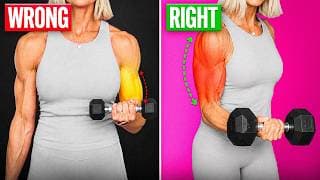
Nikkiey's 12-perfect-reps rule for knowing when you've earned a heavier weight
Plays from 16:04 · Video: 7 Lifting Mistakes That Cause Injury in Women Over 40
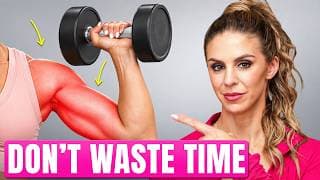
When to add two to five pounds, plus tempo training if you have no heavier weights
Plays from 12:50 · Video: 6 Dumbbell Exercises to Build Muscle During Menopause
Why it's fine to stay at the same weight for a few weeks before moving up
Plays from 20:44 · Ep. 16: How to Choose a Workout Plan and Use Progressive Overload

Mid-workout, Nikkiey on why you rarely need to jump 10 to 15 pounds
Plays from 3:32 · Video: 45-Minute Full Body Gym Workout With Dumbbells and Barbell
Why lifting too light stalls results, and how hard the last reps should feel
Plays from 1:39 · Video: 7 Lifting Mistakes That Cause Injury in Women Over 40
The full answer
Form decides when you go up, not the calendar and not your ego. On her video about lifting mistakes, Nikkiey says every pound you add has to be earned by form that's already locked in at your current weight. She means perfect form, not good-enough form: every rep looks the same, your joints feel clean, and your muscles are doing the work instead of momentum. If your back rounds on a Romanian deadlift, or your lower back arches on a press to move five more pounds, you didn't get stronger. You compensated. She admits this pace feels slow, and says it's what keeps women lifting injury-free for decades.
Keep the jumps small. On Ep. 16, Nikkiey uses the example of an incline chest press at 40 pounds one week and 45 the next, not 60. On one 10-step video she suggests aiming each week to add five pounds or two to three more reps. Ep. 16 adds a caveat: some weeks you won't hit it, and you may stay at the same weight for two weeks or longer. That's normal. In one workout video she points out that people jump 10 to 15 pounds when five would do. In that same session the five-pound bump still felt light and she went up again, so treat five pounds as a starting point and let your reps tell you.
If you can't add weight, you can still progress:
- Add reps or sets
- Shorten your rest, for example from two minutes to one between sets
- Slow the tempo, with three seconds down and three seconds up, which she says makes a 15-pound dumbbell feel like a 25
Nikkiey also warns about the opposite problem. She calls lifting too light the biggest risk in the weight room after 40. She describes a woman who used the same pink dumbbells for four months and saw nothing change. Once she moved up in weight, she saw more change in six weeks than in the four months before. The lifting wasn't failing her. The weight was too light.
From Nikkiey Stott and WarriorBabe's coaching. For education, not medical advice: talk to your doctor about your own health.
Women also ask
More questions →
Strength Training for Women
Are classes like F45 or Orangetheory enough to build muscle?
Not on their own. Nikkiey explains that F45, Orangetheory and CrossFit include strength work but don't prioritize muscle growth the way a progressive overload program does, because everyone in the room does the same workout. Keep the classes if you love them, but make them about 20% of your training and progressive lifting the other 80%.
Read the answer →
Strength Training for Women
Can I build muscle at home with just dumbbells?
Yes. On The WarriorBabe Show, the message is that muscle grows from the force it produces against resistance and how close you take it to failure. Gym machines and dumbbells are two delivery systems for that same signal. What matters is lifting heavy enough, resting enough, and gradually making it harder over time.
Read the answer →
Strength Training for Women
How can I work up to doing a pull-up?
Work up to a pull-up in stages. Nikkiey recommends starting with inverted pull-ups until they feel comfortable, then jumping up to the bar and slowly lowering yourself (negatives), then banded or machine-assisted pull-ups, and finally full bodyweight pull-ups. Each stage builds the back, arm and core strength the next one needs.
Read the answer →
Watch or listen in full
More on this topic → 14 min
6 Dumbbell Exercises to Build Muscle During Menopause
Video · Oct 3, 2026
 18 min
7 Lifting Mistakes That Cause Injury in Women Over 40
Video · Sep 4, 2026
 9 min
45-Minute Full Body Gym Workout With Dumbbells and Barbell
Video · Jun 11, 2023