

From 1 video
How often should I train glutes after 40?
Answered by Nikkiey Stott and her guests · Updated
The short answer
Train glutes twice a week. Nikkiey explains that two sessions are enough to stimulate growth and still allow recovery, and that's where most women start. As you advance you can move to three, but two well-executed sessions will always beat three sloppy ones. Progressive load, sleep and protein matter as much as frequency.
Hear Nikkiey answer it
Tap play to start right where it's answered. It keeps playing while you browse.
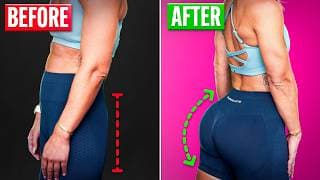
Nikkiey on why two glute sessions a week beats three sloppy ones
Plays from 13:11 · Video: Best Glute Exercises for Women Over 40 to Fix a Flat Butt
How Nikkiey splits glute exercises across two weekly sessions
Plays from 12:49 · Video: Best Glute Exercises for Women Over 40 to Fix a Flat Butt
Hip thrust sets, reps and the minimum twice-a-week frequency for growth
Plays from 5:45 · Video: Best Glute Exercises for Women Over 40 to Fix a Flat Butt
Why progressive overload, sleep and protein decide whether glutes grow
Plays from 13:40 · Video: Best Glute Exercises for Women Over 40 to Fix a Flat Butt
The full answer
Nikkiey doesn't cram every glute exercise into one day. She splits them across two sessions so your glutes get hit from every angle twice a week:
- Day one, glute and hamstring focus: hip thrusts, Romanian deadlifts, cable kickbacks.
- Day two, quad and glute focus: sumo squats and Bulgarian split squats.
For hip thrusts she programs 3-4 sets of 8-12 reps, at least twice a week for growth. Sumo squats get 3-4 sets of 10-12. The key detail is effort. If rep eight isn't challenging, go heavier. She says women are conditioned to think light weight and high reps is the safe option, but breezing through 15 easy reps gives your glutes no reason to change. Her clients often start with just the bar and, within three to four months, are hip thrusting 135, 155, some over 185 pounds.
Frequency only works alongside progression and recovery. Nikkiey explains that a beginner's first month is about pattern and consistency, not load. You're grooving the movements and building the mind-muscle connection. After that, something has to progress each week: more weight, more reps or better range of motion. If you're doing the same weight and reps every week, nothing changes. That's where most women stay stuck, and it's a plan problem, not a you problem.
Recovery is the other half. Sleep is when muscles rebuild, and protein is what they rebuild with. If you're under-eating, she says, your body doesn't have the resources to build new tissue no matter how hard or how often you train. That's why adding a third session before you've nailed two, and before your food and sleep support it, usually isn't the answer.
From Nikkiey Stott and WarriorBabe's coaching. For education, not medical advice: talk to your doctor about your own health.
Women also ask
More questions →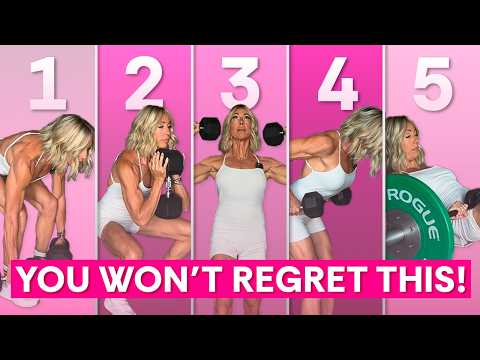
Strength Training for Women
What is the best exercise to build glutes after 40?
Nikkiey names the hip thrust as the best glute exercise after 40: nothing else activates the glutes as much under the same load. She ranks Bulgarian split squats alongside it in the top tier. Start with 3 sets of 10 to 12 reps, feeling it in your glutes, not your lower back.
Read the answer →
Strength Training for Women
How many days a week should I lift weights?
Three to four days a week is Nikkiey's core recommendation for women over 40: 30 to 45 minutes per session, built on compound lifts and progressive overload, with walking on off days and seven to eight hours of sleep. Lifting six or seven days a week, she says, breaks down muscle faster than you can rebuild it.
Read the answer →
Strength Training for Women
Are classes like F45 or Orangetheory enough to build muscle?
Not on their own. Nikkiey explains that F45, Orangetheory and CrossFit include strength work but don't prioritize muscle growth the way a progressive overload program does, because everyone in the room does the same workout. Keep the classes if you love them, but make them about 20% of your training and progressive lifting the other 80%.
Read the answer →
Watch or listen in full
More on this topic →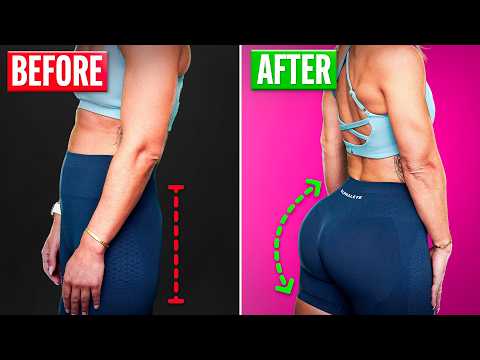 15 min
Best Glute Exercises for Women Over 40 to Fix a Flat Butt
Video · Apr 11, 2026