

Chapters
In this video
If your glutes have gone flat after 40 even though you work out, Nikkiey Stott explains why. In her view, declining estrogen in perimenopause and menopause makes it harder to build and keep muscle, and years of cardio and sitting lead to glute amnesia, where your hamstrings and lower back take over and your glutes stop firing. Banded walks, fire hydrants and donkey kicks give you a burn, but she says they belong in your warm-up, not at the center of your training.
She walks through the five loaded exercises she uses with WarriorBabe clients to train all three jobs of the glutes: hip thrusts, Romanian deadlifts, Bulgarian split squats, cable kickbacks and sumo squats. For each one you get the most common mistakes, the cues that fix them, and exactly how she programs it.
She finishes with how to split the five moves across two sessions a week, and the piece most women skip: progressive overload, sleep and enough protein. Without those, she says, the training stimulus never turns into muscle.
Key takeaways
- Banded walks, fire hydrants and donkey kicks are activation work for your warm-up; the burn they give is not the same as a growth stimulus.
- Your glutes do hip extension, hip abduction and hip external rotation, so a complete program trains all three patterns with real load.
- For hip thrusts, do 3-4 sets of 8-12 reps with your back on the bench at bra line, chin tucked, driving through your heels and squeezing for a full second at the top, and go heavier if rep eight isn't challenging.
- Learn the Romanian deadlift hinge by standing a foot from a wall and pushing your hips back until they tap it, then do 3-4 sets of 10-12 keeping the bar close to your legs.
- Start Bulgarian split squats with body weight, 3 sets of 10-12 per leg, lowering straight down with a 2-3 second descent before you add load.
- On cable kickbacks, drive your heel back like you're pushing through a wall, not kicking toward the ceiling, for 3 sets of 12-15 per leg with a hold at the top.
- Split the moves into two glute days a week: hip thrusts, RDLs and cable kickbacks on one day, and sumo squats and Bulgarian split squats on the other.
- Progress something each week, whether weight, reps or range of motion, and eat at least one gram of protein per pound of body weight spread across three to four meals.
Questions answered
Why are my glutes getting flatter after 40?
Nikkiey explains that estrogen plays a role in building and maintaining muscle, so as it declines in perimenopause and menopause, the glutes, as the largest muscle group, are one of the first places women notice the loss. Years of cardio and long hours of sitting also lead to glute amnesia, where the hamstrings and lower back do the work instead.
Are fire hydrants and banded walks enough to grow your glutes?
Nikkiey says they are not useless, but they are activation work that belongs in your warm-up. Feeling a burn is different from loading the muscle enough to force it to adapt, and women over 40 need compound, loaded movements to change their body composition.
How many sets and reps of hip thrusts should I do?
Nikkiey programs 3-4 sets of 8-12 reps at least twice a week. If rep eight isn't challenging, go heavier.
How often should women over 40 train glutes?
Most women start with two glute sessions a week, which Nikkiey says is enough to stimulate growth and allow recovery. More advanced women can move to three, but two well-executed sessions beat three sloppy ones.
Are banded kickbacks as good as cable kickbacks?
Nikkiey says they are not the same because the band loses tension at the bottom of the movement. If you don't have cables, she'd rather you do a slow, controlled banded version on all fours than swing through reps for a pump.
How much protein do I need to build glutes after 40?
Nikkiey recommends at least one gram of protein per pound of body weight every day, spread across three to four meals, because muscle needs those resources to rebuild after training.
Ask Nikkiey
Questions this video helps answer, with what Nikkiey says across everything WarriorBabe teaches.
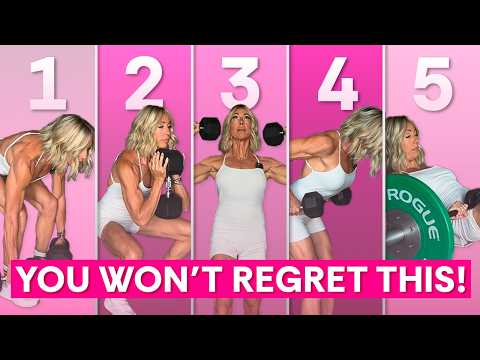
Strength Training for Women
What is the best exercise to build glutes after 40?
Nikkiey names the hip thrust as the best glute exercise after 40: nothing else activates the glutes as much under the same load. She ranks Bulgarian split squats alongside it in the top tier. Start with 3 sets of 10 to 12 reps, feeling it in your glutes, not your lower back.
Read the answer →
Strength Training for Women
How often should I train glutes after 40?
Train glutes twice a week. Nikkiey explains that two sessions are enough to stimulate growth and still allow recovery, and that's where most women start. As you advance you can move to three, but two well-executed sessions will always beat three sloppy ones. Progressive load, sleep and protein matter as much as frequency.
Read the answer →
Full transcript
Nikkiey: If you want to take your glutes from flat to defined, even after the age of 40, the five exercises I'm about to show you are the ones I've personally used to program glute training for over 1,000 women over 40. And what I've found is that almost none of them are doing the exercises that actually build glutes. Stay until the end, because the last piece is the one most women completely skip, and it's the only reason they don't see results even when they're training consistently. Let's get started.
Before we get into the exercises, I need you to understand something that completely changes the way you approach this. The reason your glutes have changed is not what most people think. It's not just age, and it's not just that you stopped working out as hard. There is a very specific biological reason your glutes are shrinking, and once you understand it, the five exercises I'm going to show you are going to make complete sense.
Here's what's actually going on. Estrogen is not just a reproductive hormone. It plays a direct role in how your body builds and maintains muscle. When it starts declining in perimenopause and menopause, your ability to synthesize muscle protein drops with it. The glutes are the largest muscle group in your body, so they are one of the first places you feel that loss. They shrink, flatten, and if you are not actively countering it, it accelerates fast.
Then there's glute amnesia. And yes, that is a real thing. If you have been doing primarily cardio for years, your glutes have essentially forgotten how to fire. Running, cycling, the elliptical: none of those movements require your glutes to be the primary driver. So your body outsources the work to your hamstrings and lower back, and your glutes just check out. Physically, that looks like a flat, soft backside that does not respond no matter how much you work out. Add 8 to 10 hours of sitting on top of that, and the neural connection between your brain and your glutes shuts down even further. Your body stops recruiting them efficiently because it simply has not needed to.
And here is a piece most women have never been told. Weak glutes are almost always the root of knee pain, low back pain and hip pain. Your glutes are the primary stabilizer of your entire lower body. When they stop firing, your knees, your back and your hips absorb that load instead. If you have been dealing with chronic pain in any of those areas, your glutes are likely the missing link nobody talked to you about.
So here's what this means for you. Your glutes haven't just gotten smaller. They have essentially gone to sleep. And before you can grow them, you have to wake them back up with the right movements.
Now let's talk about the workouts you see all over social media: banded walks, fire hydrants, donkey kicks. Here is the truth about those movements. They are not useless, but they are activation work. They belong in your warm-up, not as the centerpiece of your training. And the burn you feel from doing them is not the same as a growth stimulus. I have had so many women tell me that they feel their glutes burning during those exercises and cannot understand why nothing is changing. Feeling a muscle and actually loading it enough to force an adaptation are two completely different things.
Which brings me to load. Women over 40 specifically need compound, loaded movements to actually change their body composition. When you keep training with light resistance, your body has zero reason to build new muscle tissue. Muscle only grows when it is challenged beyond what it is already adapted to.
And here is the piece most booty workouts completely miss. Your glutes have three jobs: hip extension, hip abduction and hip external rotation. A complete glute training program needs to train all three patterns with real load. Most popular workouts are only hitting one, maybe two, of those patterns. That is why women can train consistently and still feel flat. They are not training the full muscle. The exercises I am about to show you train all three of those patterns with enough load to actually stimulate muscle growth. These are the movements I use with every single woman we program for in WarriorBabe, and the results speak for themselves. Let's get into them.
Exercise number one: the hip thrust. If women could do only one glute exercise for the rest of their lives, this would be it. The hip thrust is the most effective exercise for loading the glutes through the full range of hip extension. And unlike squats or deadlifts, where the glutes are sharing the work with your quads and your hamstrings, the hip thrust puts the glutes in the driver's seat at the top of the movement, where the muscle is fully contracted. That's where real growth happens.
Let's talk about what this looks like when a woman is starting this exercise. A woman walks in on day one and we load up her first hip thrust. It is almost always the same scene. She has never done this move before. She feels awkward with the bench behind her. And we're just starting light here, sometimes just the bar, sometimes even body weight, just to teach the pattern. The movement typically looks stiff. The range of motion is short. And nine times out of ten, she is overarching her lower back at the top instead of actually squeezing her glutes. Her lower back is doing the work because her glutes have forgotten how to fire.
The cue I use more than any other is this: tuck your chin and think about driving your hips up by squeezing your glutes, not by arching your back.
The other big mistake is going too light for too long. Women are conditioned to think light weight and high reps is the safe option. But if you are breezing through 15 reps with no real effort, you are not giving your glutes a reason to grow. We need to load this movement. I have clients start with just the bar, and within three to four months they are hitting 135, 155, some over 185 pounds. And the first physical change they almost always notice is not the actual size. It is the shape. The glutes start to lift and round out before they even feel bigger. And that is the moment women get completely hooked on this exercise.
This is how I would program this exercise into your workouts. Three to four sets of 8 to 12 reps. Back against the bench at your bra line. Feet hip-width apart. Chin tucked. Drive through your heels. Squeeze for a full second at the top. If you're not challenged by rep eight, go heavier. Minimum two times per week for growth.
Now let's get into exercise number two: a Romanian deadlift, or RDL. This is a movement that builds the posterior chain, and a strong posterior chain is what gives you that lifted, rounded look while protecting your knees and your lower back at the same time. The RDL teaches something most women over 40 have never properly learned, which is how to hinge at the hip. Once they learn that pattern, everything changes.
Teaching the hip hinge is one of my favorite things because the light bulb moment is so satisfying to watch. The cue I use most often is the wall cue. You stand about a foot away from the wall, soft bend at the knees, and push your hips straight back until they tap the wall. That is the hinge. It sounds simple, but for women who have been squatting everything their whole life, this is a completely foreign movement pattern. That deep stretch through the back of the legs is when she knows she found it. And once she feels it, she cannot unfeel it.
When women do this wrong, the most common pattern is rounding the lower back and letting the bar drift away from the body. Over time, that shows up as chronic lower back tightness and zero glute or hamstring development, because the wrong muscles are absorbing all of the load. Done correctly, the RDL is one of the most protective movements a woman over 40 can have in her program.
So this is how I program and execute this exercise. Three to four sets of 10 to 12 reps. Soft bend in your knees. Push your hips straight back like closing a car door. Keep the bar close to your legs. Drive your hips forward to stand and squeeze hard at the top. Dumbbells or a barbell both work; dumbbells are easier to start with. Then pair this exercise with hip thrusts on the same day and you'll have a strong glute and hamstring session.
Exercise number three: Bulgarian split squats. Most women over 40 have significant strength differences between their left side and their right side. Squats and deadlifts let the stronger side compensate. This exercise doesn't. The Bulgarian split squat forces each leg to work on its own, which exposes imbalances and corrects them. It also hits the glute medius, which is the side of the glute that gives you width and shape, and the hip stability that keeps you moving safely as you age.
The first reaction to this is almost universal. A woman looks at me like I'm trying to punish her when I say she has to do this exercise. It feels unstable, and within the first set she discovers that one leg is significantly weaker than the other. That is not a coincidence. That is years of compensation patterns showing up that bilateral movements let her hide.
The most common imbalances are left-to-right strength differences and the knee caving inward on the weaker side. That knee cave is a glute medius problem, and fixing it has a direct carryover to joint health. I've had women whose chronic knee pain improves significantly once we close the strength gap. We build the hip stability, and that knee pain often resolves on its own.
If you're thinking that you can barely do this with body weight, that's completely normal. Body weight Bulgarian split squats are genuinely hard, and that is a perfectly legitimate starting point. We build the pattern and the stability, then add load when the movement is clean. Where you start has nothing to do with where you end up.
So here's how I would program and execute it. Three sets of 10 to 12 reps per leg. Your rear foot elevated on the bench. Front foot far enough forward that your knee stays behind your toes. Lower straight down, not forward. Start with just body weight and get the depth right before adding load. A two to three second descent builds more muscle and improves control.
Exercise number four: a cable kickback. After the heavy compound movements, this is how you finish the job. The cable provides constant tension through the full range of motion. That's what separates this from a body weight donkey kick, where there's no resistance at the bottom of the movement. Consistent tension is what drives muscle growth. This is not the Instagram version. This is the controlled, loaded movement done with intent and mind-muscle connection.
The version I see all over social media is a woman swinging her leg as high as possible with her back arched and her torso rocking. That is not a glute exercise. That is momentum with a cable attachment. Height means nothing. What matters is whether you are actually contracting the glute through a controlled range of motion. An effective cable kickback is almost boring to watch: slight forward lean, core braced, driving back with your heel like you are pushing through a wall, not kicking toward the ceiling.
The cue I use most is to squeeze your glute like you're trying to hold something between your cheek and your hamstring. The mind-muscle connection is what separates stimulus from junk volume. If you feel it in your lower back, you are hyperextending. If you feel it in your hamstring, your hip angle is off. Both are fixable, but you have to slow down enough to notice.
As for banded kickbacks as a substitute, honest answer: they are not the same. The band loses tension at the bottom, where you need it the most. If cables are not available, I would rather you do a slow, controlled banded variation on all fours than swing through reps for a pump.
This is how to program and execute it. Do three sets of 12 to 15 reps per leg at the end of your glute session. Slight lean forward, drive the heel back and up. Squeeze hard at full extension for one to two seconds and control the return. Keep a tempo of about one second up, two second hold, two seconds down. Focus on the contraction, not the weight.
Now, exercise number five: a sumo squat. A traditional squat is quad dominant. Most women who squat are building their quads without proportionally building their glutes, which is exactly why they feel stronger but their butt stays flat. The sumo squat changes that. The wide stance and turned-out toes shift the emphasis to the glutes and inner thighs by opening the hips in a way a regular squat never does. It trains the glutes in a completely different plane than the hip thrust and RDL, which rounds out your full glute development.
Every woman who switches from regular squats to sumo says the same thing: I never felt my glutes like this before. A traditional squat is quad dominant by design. The sumo squat opens the hips and shifts the load in a way that makes the glutes impossible to ignore.
The cue that gets the glutes firing most consistently is this: as you lower down, push your knees out toward your pinky toes and sit back into your hips, not straight down. The outward knee drive is what activates the glutes and inner thighs together. The moment a woman feels it, she knows exactly why her regular squats are not changing her backside.
For beginners, I actually love the Smith machine for this movement. The fixed bar path removes the balance demand so that a woman can focus entirely on hip position and feeling the right muscles work. Once the pattern is locked in, we can move to free weights.
So this is how we program and execute it. Three to four sets of 10 to 12 reps. Feet wider than shoulder width. Toes turned out 30 to 45 degrees. Sit straight down and drive through your heels. Squeeze hard at the top. The deeper you can get safely, the more glute stretch you get at the bottom.
Now, you don't need to do all five of these in one session. Here's how I would typically split them for our WarriorBabes. Day one is a glute and hamstring focus: hip thrusts, Romanian deadlifts and cable kickbacks. Day two is more of a quad and glute focus: sumo squats and Bulgarian split squats. That combination trains your glutes from every angle twice a week, which is exactly what you need for growth.
Most women start training glutes twice a week. That is enough frequency to stimulate growth and allow recovery. As they advance, we can push it to three times a week. But two well-executed sessions will always beat three sloppy ones. A beginner's first month is about pattern and consistency, not load. We are grooving the movements and building the mind-muscle connection. Someone who has been with us for a year is adding weight regularly, and her glutes are responding because she built the foundation to actually load them.
This is where most women stay stuck: progressive overload. If you are doing the same weight and reps every week, your muscle has zero reason to change. Growth only happens when you give it a reason to. More weight, more reps, better range of motion. Something has to progress, or nothing does.
And none of that works without recovery. Sleep is when your muscles rebuild. Protein is what they rebuild with. If you are under-eating, your body does not have the resources to build new tissue, no matter how hard you train. What happens outside the gym matters just as much as what happens inside the gym. The training is a stimulus, but the stimulus only turns into muscle if your body has what it needs to actually rebuild.
Women over 40 need at least one gram of protein per pound of body weight every day, spread across three to four meals, to support what's happening in their workouts. The Macro Method is a nutrition system I built specifically for this. It gives you the protein targets, the macro balance and the framework to fuel real muscle growth without starving yourself or cutting out your carbohydrates.
And if you're not ready for that yet, start with one of my free workout plans or trainings at the link in my bio. Get consistent with the right structure first. Then, when you're ready to dial in your nutrition, the Macro Method will take you the rest of the way. Thanks for watching, guys, and I'll see you in the next video.
Up next
Everything → 30 min
Why Am I Lifting Weights But Not Seeing Muscle?
Episode 281 · Aug 1, 2025
 26 min
Getting Rid of Cellulite After 40 by Building Muscle
Video · May 27, 2026
 28 min
How to Get Toned After 40 Without Getting Bulky
Episode 356 · Apr 27, 2026
Best of Strength Training for Women
All 266 → 1 hr 1 min
Why Building Muscle Is Key to Aging Well After 40
With JJ Virgin
 31 min
Full Body Workouts vs Bro Splits: Which Is Better After 40?
Episode 64 · Jun 5, 2023
 39 min
CrossFit, F45 or Lifting: What Builds Muscle After 40?
Episode 141 · Mar 25, 2024