

From 3 episodes and 1 video
What are the different ways to do progressive overload?
Answered by Nikkiey Stott and her guests · Updated
The short answer
Nikkiey's progressive overload methods are adding weight, adding reps or sets, shortening rest between sets, changing tempo, switching equipment, varying exercises with techniques like drop sets, and eccentric training with more time under tension. Her advice is to add them one at a time, starting with weight, rather than changing everything at once.
Hear Nikkiey answer it
Tap play to start right where it's answered. It keeps playing while you browse.
Nikkiey on adding overload methods one at a time, then equipment and drop sets
Plays from 22:17 · Ep. 16: How to Choose a Workout Plan and Use Progressive Overload
Nikkiey walks through weight, reps, sets, shorter rest and tempo changes
Plays from 12:05 · Ep. 53: How to Use Progressive Overload to Build Muscle

Nikkiey shows four overload methods in one session with 70-year-old Julie
Plays from 13:09 · Video: Strength Training at 70 With Knee Replacements and Scoliosis
Why progressive overload still drives Nikkiey's full body training
Plays from 3:23 · Ep. 64: Full Body Workouts vs Bro Splits: Which Is Better After 40?
The full answer
Nikkiey covers this on Ep. 16 and Ep. 53, and the lists line up closely. On Ep. 16 she gives seven ways:
- Increase resistance or weight over time
- Add reps or sets
- Decrease rest time between sets, for example going from two minutes to one minute on a back squat
- Change the speed of the movement
- Use different equipment, like moving from barbells to dumbbells or dumbbells to cable
- Vary your exercises, including drop sets, where you go to failure, immediately drop the weight and keep going to failure again
- Eccentric training, slowing the lowering portion of a lift to put more time under tension
There is one nuance between the episodes. On Ep. 16 she describes speeding up a movement as its own method. On Ep. 53 she treats tempo as working in both directions, speeding up or slowing down, and gives an example of moving from a 4-0-1-0 tempo to 3-0-1-0 to 2-0-1-0 over successive weeks. She also suggests putting drop sets at the end of a workout.
The how matters as much as the what. On Ep. 16 Nikkiey asks you not to stack them all at once: start with weight, then play with sets and reps, then rest time, adding one technique at a time. On Ep. 53 she says she adjusts reps and sets within a block, while the other methods can be rotated weekly or by training block. On Ep. 64 she adds that even with full body training, she still progresses through sets, reps, RPE, percentages, drop sets and tempo.
In a video session with Julie, a 70-year-old client, Nikkiey shows several methods in one workout: an added set, added weight, rest cut from 90 to 60 seconds, and reps raised from 12 to 15. She points out that the last week of a training block is a good time to push the muscles a little harder.
From Nikkiey Stott and WarriorBabe's coaching. For education, not medical advice: talk to your doctor about your own health.
Women also ask
More questions →
Strength Training for Women
What is progressive overload?
Progressive overload is gradually increasing the stress you place on your muscles over time so they keep having a reason to adapt and grow. Nikkiey explains you do it by adding small amounts of weight, reps, sets, or changing tempo and rest, while sticking with the same exercises long enough to measure progress.
Read the answer →
Strength Training for Women
Are classes like F45 or Orangetheory enough to build muscle?
Not on their own. Nikkiey explains that F45, Orangetheory and CrossFit include strength work but don't prioritize muscle growth the way a progressive overload program does, because everyone in the room does the same workout. Keep the classes if you love them, but make them about 20% of your training and progressive lifting the other 80%.
Read the answer →
Strength Training for Women
Are full body workouts better than body part splits for women over 40?
For most women over 40, Nikkiey Stott recommends full body workouts over body part splits. One exercise per muscle group, four to five days a week, spreads the work out so you recover between sessions and stay consistent. She's clear that bro splits aren't bad, though. Progressive overload is what matters most.
Read the answer →
Watch or listen in full
More on this topic →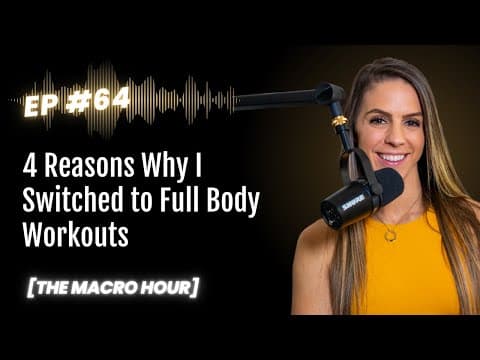 31 min
Full Body Workouts vs Bro Splits: Which Is Better After 40?
Episode 64 · Jun 5, 2023
 19 min
How to Use Progressive Overload to Build Muscle
Episode 53 · May 10, 2023
 27 min
How to Choose a Workout Plan and Use Progressive Overload
Episode 16 · Feb 13, 2023