

Chapters
In this video
Most of the training advice you've been given was built from research on men and handed to you as if it would work the same way. In this video, Nikkiey Stott walks through seven training rules women over 40 should stop following, and what to do instead based on how a woman's body actually works.
She covers timing your rest between sets, moving from machines to free weights, swapping crunches for compound lifts, and why she sees light weights with high reps as the piece of advice that has held back more women over 40 than anything else. She also explains why she would swap long treadmill sessions for short sprint intervals, why she calls creatine the most important supplement for women over 40, and why training six or seven days a week can work against you.
You'll hear how Lara, a CFO and COO who was training six days a week, under-eating and burning out, turned things around by training less, lifting heavier and eating more, and how Johanna started at 62 after two total knee replacements. The video ends with a simple weekly structure: three to four strength sessions, one to two sprint interval sessions, two to three full rest days and daily walks.
Key takeaways
- Time your rest with a phone timer: 60 to 90 seconds for compound lifts like squats, deadlifts and presses, and 45 to 60 seconds for isolation work like curls and lateral raises.
- Once you've trained for more than a couple of months, move most of your training from machines to free weights, starting with goblet squats, dumbbell rows, overhead presses and Romanian deadlifts. Cables are fine too.
- Replace dedicated ab workouts with compound movements like squats, deadlifts, overhead presses and farmer carries three to four days a week, because your core works harder stabilizing under load than in a crunch.
- Lift heavy for you: three to four compound lifts per session, three to four sets of six to ten reps, with a weight that feels hard by rep seven or eight. If you can do 15 reps easily, it's too light.
- Keep giving your muscles a reason to grow by gradually increasing the weight over time, which is progressive overload.
- Swap long steady-state cardio for sprint intervals once or twice a week: 30 seconds all out, one to two minutes of full recovery, four to five rounds, about 12 to 15 minutes total. Keep your daily walks.
- Nikkiey recommends 3 to 5 grams of creatine every day, not just on training days, mixed into water, coffee or a smoothie.
- Train three to four days a week with real intensity and take two to three full rest days. Nikkiey explains that training every day without recovery keeps cortisol chronically elevated, which tells your body to store fat around your midsection.
Questions answered
How long should women over 40 rest between sets?
Nikkiey recommends 60 to 90 seconds for compound movements like squats, deadlifts and presses, and 45 to 60 seconds for isolation work like curls and lateral raises. Set a timer and pick the weight back up when it goes off, because resting four or five minutes lets your muscles cool down and breaks up the training effect.
Do crunches flatten your stomach?
According to Nikkiey, no. Crunches train one small movement pattern, don't burn enough calories to reduce body fat and don't build enough muscle to change your shape. She recommends compound movements like squats, deadlifts, overhead presses and farmer carries instead.
What counts as heavy weight for women over 40?
Heavy is relative to you. It's a weight where you couldn't do three more reps with good form, used for six to ten reps, so that the last two reps are genuinely difficult and the weight feels hard by rep seven or eight.
Is long cardio good for fat loss after 40?
Nikkiey calls long treadmill or elliptical sessions one of the least efficient ways to lose fat after 40. She recommends sprint intervals once or twice a week instead, 30 seconds all out with one to two minutes of full recovery for four to five rounds, while keeping daily walks for overall health.
How much creatine should women over 40 take?
Nikkiey recommends 3 to 5 grams per day, roughly half a teaspoon, taken every day rather than only on training days. She says it mixes into water, coffee or a smoothie and won't make you bulky.
How many days a week should women over 40 work out?
The structure Nikkiey lays out is three to four strength sessions per week, one to two sprint interval sessions that can be done right after strength work, two to three full rest days and daily walking. She says more than this is counterproductive after 40.
Ask Nikkiey
Questions this video helps answer, with what Nikkiey says across everything WarriorBabe teaches.

Strength Training for Women
How long should I rest between sets to build muscle?
Nikkiey's starting point is 60 to 90 seconds between sets for compound lifts like squats, deadlifts and presses, and about 45 to 60 seconds for isolation moves like curls. On heavier compound work she'll go up to two minutes. Above all, time it, because four or five minutes of scrolling breaks up the training effect.
Read the answer →
How to Get Toned
Do crunches flatten your stomach after 40?
No. Nikkiey says crunches won't flatten your stomach after 40, because you can't spot reduce belly fat and crunches don't burn enough calories or build enough muscle to change your shape. What works is full-body strength training like squats, deadlifts and carries, enough protein, recovery, and lowering your overall body fat.
Read the answer →
Supplements & Creatine
How much creatine should a woman over 40 take?
Nikkiey recommends 3 to 5 grams of creatine monohydrate a day, roughly half a teaspoon, taken every day rather than only on training days. No loading phase and no cycling. She takes 5 grams each morning stirred into her coffee, and says it mixes easily into water or a smoothie.
Read the answer →
Full transcript
Nikkiey: Almost every training rule that you've ever been given was designed for a man's body. The rest periods, the rep ranges, the exercises, the supplements, all of it was built from research on a man and then handed to you as if it would work the same way. It doesn't. And after 40, the gap between what works for a man and what works for a woman gets even wider. So today I'm going to walk you through seven training rules that you need to stop following immediately, and what to do instead based on how your body actually works.
Here's something nobody ever explains to you when you start training. The time that you spend between sets matters just as much as the sets themselves. And most women I work with have never once timed their rest. They finish a set, they put their weight down, they check their phone, they scroll for a minute, they look around, maybe grab some water. And by the time they pick that weight back up, four or five minutes have passed and they don't even realize it. That's not resting. That's losing your workout in 30-second increments.
Rest exists for one reason: to let your muscles recover just enough to perform the next set at the same intensity. That's it. It's not a break. It's not downtime. It's a deliberate pause that keeps your muscles engaged and your heart rate in the range that drives real change. When you rest for too long, and most women rest way too long without even knowing it, your muscles cool down, your heart rate drops, and you lose the training effect that you just built. You end up doing the same number of sets and reps as someone who rested properly, but getting half the results because the stimulus was broken up by five-minute gaps.
Women are actually more fatigue resistant than men, meaning your muscle fibers recover faster between bouts of effort. You're ready to go sooner than you think. Your body just needs 60 to 90 seconds, not five minutes of scrolling. So here's your new rule. Set a timer on your phone. 60 to 90 seconds for compound movements like squats, deadlifts and presses. 45 to 60 seconds for isolation work like curls and lateral raises. And when the timer goes off, you pick that weight back up and get to work. No negotiating with yourself. You'll be shocked at how much faster your workouts get and how much harder they feel, because you're actually keeping the stimulus continuous instead of letting it leak out between sets.
I get why machines feel safe. You sit down, the movement is guided, you don't have to think about balance or form, and nobody's watching you figure out what to do with a dumbbell. When you're new to the gym or coming back after years away, machines feel like the responsible choice. And for your first few weeks, they are. But if you've been training for more than a couple of months and you're still spending most of your time on machines because free weights feel intimidating, you're staying comfortable at the cost of your results.
Free weights aren't as scary as they look. A goblet squat is holding one dumbbell in front of your chest and sitting down. A dumbbell row is leaning on a bench and pulling a weight to your hip. These aren't complex Olympic lifts. They're simple movements that force your stabilizer muscles to engage. And that matters more after 40 than at any other point in your life. Joint stability is what keeps you training injury-free decade after decade.
Think about how you actually move in real life. You don't lift your groceries on a track. You pick them up, carry them, twist, stabilize with your whole body. That's what free weights train: real movement patterns that transfer to your actual life. Machines isolate one muscle in one direction. Your body doesn't work that way.
So here's the switch. Start with four movements: goblet squats, dumbbell rows, overhead presses and Romanian deadlifts. That's it. Start light, learn your form, and you can use cables too. Cables are fine because they allow a free movement path. But the goal is to spend most of your training with weights that make your body stabilize itself, not sitting on a machine that does the stabilizing for you. You're stronger than you think, and the weights are less intimidating than they look once you actually pick them up.
Women naturally carry a lower center of gravity than men. That changes which core exercises actually work for our bodies. Men can isolate their abs with crunches and see results because their body distributes force differently through their trunk. For women, the exercises that build real, visible, functional core strength are compound movements like squats, deadlifts, overhead presses and farmer carries, where your entire core has to stabilize your body under that load. When you do a heavy goblet squat, your abs are working harder to keep you upright than they ever work during a crunch. And you're not just training your abs. You're building your legs, your glutes and your back at the same time. One exercise doing the work of four.
Crunches don't flatten your stomach. They train one tiny movement pattern that doesn't transfer to anything useful in your life. They don't burn enough calories to reduce body fat. They don't build enough muscle to change your shape. And if you're doing hundreds of them with poor form, which most people are, they're putting unnecessary stress on your lower back and neck.
Here's what to do instead. Replace your dedicated ab workout with compound movements like squats, deadlifts, overhead presses and farmer carries three to four days a week. Your core will work harder in one set of heavy goblet squats than it does in a hundred crunches. And you'll actually see the results in the mirror. Your posture will improve, your back pain will decrease, and your abs show up naturally when you stop isolating them and start using them the way they were designed to: as stabilizers that hold your entire body together under load.
This is the biggest one. If you're over 40, and especially if you're in perimenopause or postmenopause, the light weight, high reps for toning advice is actively working against you. And I don't say that lightly. This one piece of bad advice has held back more women over 40 than anything else I've seen in more than a hundred thousand coaching relationships with women.
When you're in your twenties and your thirties, your hormones support building muscle across a wide rep range. High reps with lighter weights work fine because your hormonal environment, your estrogen, your testosterone, your growth hormone, they're all doing a lot of the heavy lifting behind the scenes. Your body responds to almost any form of resistance because the hormonal signal is strong.
After 40, and especially after menopause, that hormone support drops significantly. Estrogen declines, testosterone declines. The high-rep, low-weight approach that works in your twenties no longer challenges your nervous system enough to maintain muscle, let alone build it. You're doing the work, you're putting in the time, but your body isn't getting the signal it needs to adapt because the weight isn't heavy enough to force the response.
What does force the response? Heavy weights, lower reps. Six to 10 reps with a weight that makes the last two reps genuinely difficult. That's what protects your muscles, your bones and your brain as you age. Now, I know it's scary. Heavy doesn't mean dangerous. Heavy means relative to you. It means a weight where you couldn't do three more reps with good form. If someone asked you to squeeze out three more, you'd say no. That's the right intensity.
Women start losing muscle mass as early as 30. After menopause, the rate accelerates dramatically. The only thing that reverses that trajectory is challenging your muscles with enough resistance to force them to grow. Light weight doesn't create that challenge. That keeps you comfortable, and comfortable doesn't mean building muscle after 40.
Nobody told you that this was wrong because the fitness industry makes more money selling you the idea that toning is a thing. Toning is not a thing. There is building muscle and there is losing fat. Those are the two levers. Light weights with high reps do neither one effectively after 40.
So here's your protocol. Three to four compound lifts per session: squats, deadlifts, rows, presses. Three to four sets of six to 10 reps. The weight should feel hard by rep seven or eight. If you can do 15 reps easily, it's way too light. Go heavier and gradually increase the weight over time. That's progressive overload, which just means that your muscles keep getting a reason to grow instead of staying the same.
Before I get into rule number five, I want to tell you about Lara, because Lara is a perfect example of what happens when a smart, driven woman follows all the wrong rules. Lara is a CFO and a COO of a $50 million company. She does not lack discipline. She was working out six days a week. She was eating less than her body needed, and she was doing everything the conventional advice told her to do. More sessions, fewer calories, push harder.
The result was joint pain, and brain fog so bad that it was affecting her ability to do her job. She was exhausted. She was overtraining, and it was getting worse, not better. Six days a week in the gym, and her body was breaking down.
So when Lara came to us, the first thing that changed was the training volume. Six days dropped. The intensity went up. The weights got heavier. The rest got shorter. Nutrition went up, because her body was running on fumes and couldn't recover from the training that she was doing, let alone build muscle from it.
28 months later, Lara competed in the figure category twice, in August and October. The joint pain is gone. Her energy is back. She's sleeping through the night again. Her mind is clear. Her husband saw the changes, and he also joined her on this journey. She didn't get there by doing more. She got there by doing less of the wrong things and more of the right things, everything that I'm walking you through today.
If you're watching this right now and thinking, where do I even start? Take the free quiz linked in the description. It takes 60 seconds and tells you exactly what your body needs right now based on where you are today.
The treadmill for 45 minutes. The elliptical for an hour. The Saturday morning jog you've been doing since your 30s. If fat loss is your goal after 40, this is one of the least efficient ways to get there. And I know that might be hard to hear, because cardio feels so productive. You sweat. You feel tired. It seems like it should be working. But feeling tired and getting results are two completely different things.
Here's the science. Most women naturally have fewer type 2 muscle fibers, which produce lactate. And lactate is one of the key drivers of body composition change. It signals your body to build lean tissue and burn stored fat. Long, steady-state cardio produces very little lactate. You're working, but you're not producing the chemical signal that actually changes your body.
What does produce that signal? Short, high-intensity bursts. 30 seconds of full-out effort followed by one to two minutes of full recovery, repeated four to five times. That's sprint interval training. And in 15 minutes, it produces more of the metabolic response that changes your body composition than an hour on the treadmill ever will.
That doesn't mean running. Sprint intervals can be kettlebell swings, battle ropes, heavy dumbbell thrusters, bike sprints, rowing sprints, anything where you can go truly all out for 30 seconds. Pick the one that you like. The movement doesn't matter as much as the intensity does. And the recovery is just as important as the work. One to two minutes of rest between rounds so that you can actually go all out again. If you're only resting 30 seconds, you can't produce the intensity that makes this work. It just turns into regular cardio with extra suffering. Rest fully, go all out. That's the protocol.
Once or twice a week is enough. This replaces your long cardio sessions. It doesn't stack on top of them. You're freeing up hours in the gym every week. Walking is still great. I want to be really clear about that, because it helps your digestion, your mood, your joints, your sleep and your overall health. So keep your daily walks. Love your daily walks. Just stop treating the treadmill like a fat loss tool, because after 40, it's one of the weakest tools that you have.
So here's your protocol. Sprint interval training one to two times per week. 30 seconds all out, one to two minutes of full recovery. Repeat it for four to five rounds. Total session time is about 12 to 15 minutes. Keep your daily walks in, but drop those 45-minute treadmill sessions.
If someone told you that creatine is for bodybuilders or that it'll make you bloated and bulky, they were wrong. Creatine is the single most important supplement for women over 40, and it's not even close. The fact that most women have never been told this is one of the biggest failures of the supplement industry.
Women naturally carry only 70 to 80% of the creatine stores that men do. We start at a deficit. And creatine doesn't just help your muscles. It supports your brain, your heart and your gut lining. After 40, when cognitive health, cardiovascular health and digestive health all become more pressing concerns, filling that creatine gap becomes one of the highest-impact things that you can do.
And here's the part nobody talks about with creatine. Creatine actually supports and protects your gut lining. Women experience so many GI issues at higher rates than men: bloating, IBS, digestive discomfort. Creatine helps reduce that distress by strengthening that intestinal barrier. This is not a bodybuilding supplement. This is a health supplement that also happens to help you build muscle and recover faster from training.
The recommended amount is 3 to 5 grams per day. That's roughly half a teaspoon. Mix it in with your water, your coffee or your morning smoothie. It's tasteless and it dissolves easily. Take it every day, not just your training days. Your body needs a consistent supply to keep the stores topped off.
And listen, you won't bulk up from creatine. You won't get puffy or bloated if you use the right form. What you will notice is that you feel stronger in the gym. You're going to recover faster between sessions. And over time, your thinking becomes sharper. That's the creatine working on your brain, not just your muscles.
So here's what I recommend. 3 to 5 grams of creatine daily. Every day, not just on your training days. Mix it into any liquid. This is the one supplement that every woman over 40 should be taking, and most of you have never been told that because the marketing was always aimed at men.
If you're training six or seven days a week and you're not seeing results, the problem isn't that you need to do more. The problem is you're doing too much. And I know that sounds counterintuitive. It goes against everything diet culture has taught you: that more effort equals more results, that rest is lazy, that if you're not sore, you didn't work hard enough. None of that is true after 40.
After 40, your body's recovery capacity completely changes. The cortisol response to training is different than it was in your 20s and your 30s. Cortisol is your stress hormone. When you train, cortisol spikes. That's completely normal. But when you train every single day without adequate recovery, cortisol stays elevated chronically. And chronically elevated cortisol does one thing very effectively. It tells your body to store fat, especially around your midsection, the very thing you're training to get rid of. Overtraining is making it worse.
I've coached over 100,000 women through this exact realization. The ones who train three to four days a week with real intensity, heavy weights, the rep ranges I described and proper rest periods, recover better, build more muscle and lose more fat than women who train every single day at moderate intensity, every time. It's not even close.
Rest days are not lazy days. Rest days are when your muscles actually grow. Training tears muscle fibers down. Rest and nutrition rebuild them stronger. If you're never giving your body time to rebuild, you're tearing it down faster than it can recover. You're running on a treadmill of damage.
The women I work with who get the best results train three to four days, hit it hard, and then they rest. They walk on their off days. They sleep. They get enough protein. And their bodies transform because the recovery is where the transformation actually happens. If you feel guilty about rest days, that's diet culture talking. Not science. Not results. It's just guilt.
So here's your weekly structure. Three to four strength training sessions per week with compound lifts and the rep ranges that we talked about. One to two sprint interval sessions, which can be done right after that strength work. And then give yourself two to three full rest days. Daily walking for your general health, but that's it. That's the complete program. More than this is counterproductive after 40.
Johanna joined us at 62 years old, right after two total knee replacements, thinking that her strongest years were behind her. She said that she has more energy now than she's had in years and feels stronger and more self-confident than ever. She didn't get there by training more. She got there by training right. Heavy weights, shorter rest, compound movements, proper recovery, everything that I just walked you through.
You were never failing at this. You were following rules that were never built for your body. Now you know what to do differently. But training is only one half of the equation. If you're training right and still not seeing results, your nutrition is the bottleneck. And it starts with what you eat first thing in the morning. I made a video showing you five high-protein breakfasts that you can make in 20 minutes that actually hit your macros. No guesswork, no meal prep marathons. That video is right here.
Take the free quiz in the description as well. It takes 60 seconds and tells you exactly where to start. I'll see you in the next video.
Up next
Everything →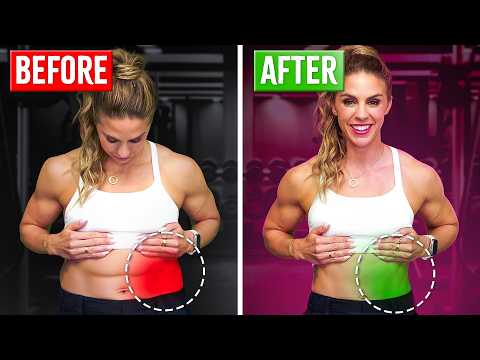 6 min
Best Strength Exercises for Women Over 40: 10 Key Moves
Video · Oct 12, 2025
 37 min
What Does Getting Toned Really Mean for Women Over 40?
Episode 201 · Oct 25, 2024
 18 min
How Much Protein Do Women Over 45 Need for Fat Loss?
Episode 78 · Jul 17, 2023
Best of Strength Training for Women
All 266 → 1 hr 1 min
Why Building Muscle Is Key to Aging Well After 40
With JJ Virgin
 30 min
Why Am I Lifting Weights But Not Seeing Muscle?
Episode 281 · Aug 1, 2025
 31 min
Full Body Workouts vs Bro Splits: Which Is Better After 40?
Episode 64 · Jun 5, 2023