

The short answer
Track alcohol by assigning the drink's calories to carbs or fat. On The WarriorBabe Show, Nikkiey divides the total calories by 4 to log them as carbs, or by 9 to log them as fat. A 100-calorie can of Truly becomes about 25 grams of carbs or about 11 grams of fat, even though its label lists only 2 grams of carbs.
Hear it answered
Tap play to start right where it's answered. It keeps playing while you browse.
Nikkiey shows how to log a can of Truly as carbs or fat
Plays from 5:41 · Ep. 166: How Alcohol Affects Fat Loss and Muscle After 40
Amy on thinking alcohol was free because her app ignored her macros
Plays from 16:37 · Ep. 310: How to Lose Body Fat in Menopause by Eating More
Nikkiey on why fitting drinks into your macros isn't the whole story
Plays from 9:22 · Ep. 359: Does Alcohol Stop Fat Loss? What Women Over 40 Should Know
Nikkiey's framework for drinking without stalling your fat loss
Plays from 24:50 · Ep. 359: Does Alcohol Stop Fat Loss? What Women Over 40 Should Know
The full answer
Nikkiey explains on Ep. 166 that the label can mislead you. A 100-calorie can of Truly lists only 2 grams of carbs, which accounts for about 8 calories. Most of the rest comes from alcohol, which carries 7 calories per gram, and the label doesn't show that as a macro. So the calories have to land somewhere in your numbers. This is what WarriorBabe recommends:
- Take the drink's total calories.
- Divide by 4 to log it as carbs, or by 9 to log it as fat.
- Take it out of whichever macro you have room in that day.
Watch how fast it adds up. Nikkiey points out that four cans of Truly are 100 grams of carbs before you've eaten anything. On Ep. 310, WarriorBabe client Amy shares that MyFitnessPal subtracted calories for her drinks without touching her macros, so she assumed they were free. Hearing on the podcast that the calories have to come out of carbs or fats helped explain some of her stalled results. If your app does the same, adjust it by hand.
On Ep. 359, Nikkiey adds an important point. Tracking your drinks is part of the strategy, but the calories are the smallest part of why alcohol affects fat loss. The pause in fat burning, the food decisions that follow a few drinks, sleep disruption and cortisol elevation never show up in your app. That's why two women can drink the same amount and get very different results.
Her approach: drink intentionally, choose lower-calorie options, front-load protein on drinking days, plan for food situations ahead of time, protect your sleep and get back on track the next day. She says one or two intentional occasions a week fit with steady progress. The pattern that quietly undoes results is frequent, unplanned drinking, not the occasional night you log honestly.
From WarriorBabe's coaches (how we write our answers). For education, not medical advice: talk to your doctor about your own health.
Women also ask
More on Macros & Macro Tracking →
Macros & Macro Tracking
Are online TDEE and macro calculators accurate?
Not very, according to Nikkiey. Online TDEE and macro calculators only use your height, age, weight and activity level, so they miss menopause, muscle mass, dieting history and lifestyle. She says they often disagree with each other. Treat any number as a rough starting point and adjust it based on how your body actually responds.
Read the answer →

Macros & Macro Tracking
Does counting macros really work for weight loss after 40?
Yes, for many women it does, because it replaces guesswork with structure. On The WarriorBabe Show, women over 40 describe losing fat and building muscle once they tracked macros and lifted. One nuance: guest Jordan Syatt says that for pure fat loss, calories, protein and fiber matter most, and full macros are optional.
Read the answer →
Macros & Macro Tracking
Should I track macros in grams or percentages?
Track in grams. Nikkiey explains that percentage goals shift whenever your total calories shift. A 40% protein goal is a different amount on a 1,600-calorie day than on a 2,100-calorie day. Fixed gram targets, like 150 grams of protein, give you a stable number to build meals around, measure progress against and troubleshoot.
Read the answer →
Macros & Macro Tracking
How long does tracking macros take each day?
Expect up to an hour, sometimes an hour and a half, a day at first. On The WarriorBabe Show, Nikkiey Stott says that drops with a couple of weeks of consistent practice, to 30 minutes, then about 10. Years in, she logs her day in two to three minutes, and client Debra does hers in about two.
Read the answer →
Macros & Macro Tracking
How much fiber do women over 40 need?
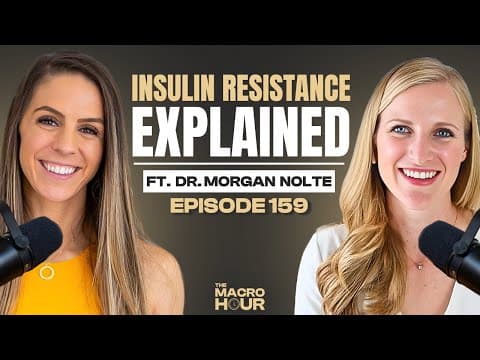
Guests on The WarriorBabe Show put it at 20 to 30 grams of fiber a day (Dr. Morgan Nolte, Ep. 159), with at least 25 grams as the floor (Dr. Jolene Brighten, Ep. 279). Fiber slows the blood sugar response, feeds your gut bacteria and helps you feel full, which is why it sits next to protein in their plans.
Read the answer →

Macros & Macro Tracking
Do I have to track macros forever?
No. Nikkiey is clear that you don't have to track macros for the rest of your life. Tracking and weighing your food is a temporary, educational phase that teaches you what real portions of protein, carbs and fat look like. Do it consistently for a couple of years and it becomes second nature.
Read the answer →
Watch or listen in full
More on this topic → 51 min
How to Lose Body Fat in Menopause by Eating More
Episode 310 · Nov 10, 2025
 27 min
Does Alcohol Stop Fat Loss? What Women Over 40 Should Know
Episode 359 · May 8, 2026
 28 min
How Alcohol Affects Fat Loss and Muscle After 40
Episode 166 · Jun 7, 2024