

From 1 episode and 4 videos
Can I just copy someone else's macros or meal plan?
Answered by Nikkiey Stott, Maggie Topham and WarriorBabe's coaches · Updated
The short answer
No. WarriorBabe's coaches explain that another woman's macros or meal plan were built for her metabolism, muscle mass, hormones, activity level, stress, sleep and history, not yours. You need your own numbers, based on your age, weight, muscle mass, activity level and goals, and those numbers should be adjusted as your body changes.
Hear it answered
Tap play to start right where it's answered. It keeps playing while you browse.

Maggie on why an influencer's meal plan was never built for your body
Plays from 7:40 · Video: Why Fitness Content Fails Women Over 40: 5 Lies
Why no two women should share macro numbers, and who should set yours
Plays from 7:06 · Ep. 67: How to Build Muscle and Lose Fat During Menopause

Why a woman over 50 can't run a 30-year-old's numbers
Plays from 4:40 · Video: How to Personalize Macros and Workouts to Get Toned
How to start building your own macros, beginning with protein
Plays from 3:08 · Video: Menopause Belly Fat Meal Plan: A High-Protein Day of Eating

Why her dinners only work once you know your own macro numbers
Plays from 9:51 · Video: Quick High-Protein Dinners to Hit Your Macros After 40
The full answer
Maggie's example: a meal plan built for a 28-year-old influencer with 15 years of training behind her has nothing to do with a 53-year-old woman in perimenopause or postmenopause who started lifting six weeks ago. When the copied plan doesn't work, most women blame their discipline. Maggie's answer is that your body isn't broken. The plan was never built for it. One WarriorBabe coach did this herself for years, stitching together keto, a metabolic program and bits of other diets. In her words, she had every piece of the puzzle, but they were all from different puzzles.
Age and goals change the math too. In her video on personalizing macros, Nikkiey says a woman over 50 doesn't burn as many daily calories as a 30-year-old, and her body's processes are different. That's why borrowing a friend's plan often works for about two weeks and then stalls. Your goal matters as well. Losing body fat calls for a different plan than holding your weight steady while you build muscle.
What WarriorBabe's coaches recommend instead:
- On Ep. 67, Nikkiey says no one should have the same macronutrient numbers as someone else. She suggests working with a professional to set your starting numbers and adjust them along the way. That episode also shares the split WarriorBabe uses for women in menopause: 35% protein, 27% carbs, 38% fat. It's a ratio, not a set of numbers to copy, because your actual grams still depend on your body.
- In a high-protein meal plan video, one WarriorBabe coach suggests starting with about 1 gram of protein per pound of body weight. You then fill in carbs and fats based on how active you are and how your body responds, using a macro calculator or, better, a coach.
- One WarriorBabe coach's own dinners are good ideas, but they only work once you know your own numbers. The macros you start with won't be the ones you end with.
From WarriorBabe's coaches (how we write our answers). For education, not medical advice: talk to your doctor about your own health.
Women also ask
More on Macros & Macro Tracking →
Macros & Macro Tracking
Should I weigh meat raw or cooked when tracking macros?
On The WarriorBabe Show, one WarriorBabe coach weighs her meat after it's cooked. She cooks the chicken, puts it on a food scale in ounces, then logs that exact weight in MyFitnessPal. The point is to log exactly what you're eating instead of guessing. The episodes don't compare raw and cooked weights directly.
Read the answer →
Macros & Macro Tracking
Is counting macros just another diet?
No. Nikkiey Stott says counting macros isn't a diet but a skill set that serves you for life. Diets are temporary and hand you rules to eliminate foods. Macros don't ask you to cut anything out. Your numbers should fit your lifestyle and goals, and over time you learn portions well enough to eyeball a plate.
Read the answer →

Macros & Macro Tracking
Do I have to track macros forever?
No. Nikkiey is clear that you don't have to track macros for the rest of your life. Tracking and weighing your food is a temporary, educational phase that teaches you what real portions of protein, carbs and fat look like. Do it consistently for a couple of years and it becomes second nature.
Read the answer →
Macros & Macro Tracking
Should my macros be different for losing fat than for building muscle?
Yes. Nikkiey Stott says fat loss and muscle building need different game plans. Protein holds steady or goes up in both, around one gram per pound or more, while calories move: a slow, gradual deficit to lose fat, and a slow climb into a surplus, mostly from carbs, to build muscle.
Read the answer →
Macros & Macro Tracking
How should I balance protein, carbs and fat at each meal?
Maggie splits each meal into roughly 35 to 40 grams of protein, about the same amount of carbohydrates, and around 15 to 20 grams of fat. She says this balance keeps her satisfied, gives her the energy to push hard in her workouts and keeps her blood sugar regulated.
Read the answer →
Macros & Macro Tracking
How do I make tracking macros less overwhelming?
Make the job smaller at first. The women on the show who stuck with it started small: tracking only protein, planning one day and repeating it, or picking a few meals from a sample plan. Nikkiey says week one might take half an hour a day, but by week three or four it takes five to ten minutes.
Read the answer →
Watch or listen in full
More on this topic →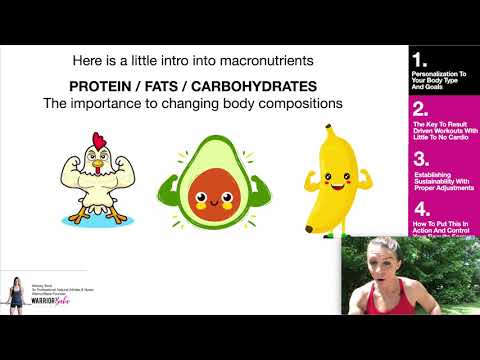 23 min
How to Personalize Macros and Workouts to Get Toned
Video · Jul 23, 2020
 10 min
How to Build Muscle and Lose Fat During Menopause
Episode 67 · Jun 12, 2023
 15 min
Why Fitness Content Fails Women Over 40: 5 Lies
Video · Aug 28, 2026