

From 1 episode and 2 videos
Is HIIT bad for women in menopause?
Answered by Nikkiey Stott and WarriorBabe's coaches · Updated
The short answer
Not necessarily. One WarriorBabe coach explains that what backfires in menopause is long, frequent, exhausting cardio, which keeps cortisol elevated and encourages belly fat storage. Short sprint interval training, with 20 to 30 second all-out efforts and full rest, is one of her core exercises. For everything else, she favors low-impact incline walking.
Hear it answered
Tap play to start right where it's answered. It keeps playing while you browse.

One WarriorBabe coach on why long or frequent cardio raises cortisol and belly fat in menopause
Plays from 2:15 · Video: Best Exercises for Menopause Belly Fat After 50

Why one WarriorBabe coach swaps high intensity cardio for incline walking after lifting
Plays from 5:04 · Video: 25-Minute Dumbbell Workout for Menopause Belly Fat
Jessica Suchan on capping HIIT at two short sessions a week
Plays from 35:43 · Ep. 114: How to Balance Hormones Naturally With Food and Exercise
One WarriorBabe coach's sprint interval protocol, step by step
Plays from 2:51 · Video: Best Exercises for Menopause Belly Fat After 50
The full answer
The problem is rarely intensity itself. It's how most women do it. One WarriorBabe coach says that during menopause, as estrogen drops, muscle becomes harder to hold onto, fat shifts toward the belly, and cortisol rises. Long cardio sessions, and interval workouts that run too long or happen too often, keep cortisol chronically elevated. In her words, that means more belly fat, not less, and more exhaustion with nothing to show for it. That's why, in her 25-minute dumbbell workout, she says high intensity cardio often backfires for women over 40 and finishes with incline walking instead.
What she does recommend is sprint interval training, kept deliberately short. She calls it non-negotiable and credits it with getting her off her first plateau. Her approach:
- Warm up for 3 to 5 minutes at an easy pace.
- Sprint at maximum effort for 20 to 30 seconds on a treadmill, bike, stairs, rower, track or jump rope.
- Rest completely for 90 seconds to 2 minutes.
- Repeat for 3 to 8 rounds, starting small and building up. Don't go longer. The intensity is the point, not the duration.
For the rest of her cardio, she uses low-impact incline walking after lifting: 10 minutes at an 8 to 12% incline and around 2.5 to 3 miles per hour, extended to 15 to 30 minutes only if it feels good. She calls it one of the safest, most effective ways to burn fat after lifting, especially in menopause.
On Ep. 114, holistic health coach Jessica Suchan adds a similar caution for women who still have a cycle: no more than two HIIT sessions a week, each under 20 to 30 minutes, balanced with strength training and restorative movement like walking and yoga, because more than that is a stress on the body. If you've been grinding through long, punishing workouts and seeing nothing, that's not a willpower problem. It's the plan.
From WarriorBabe's coaches (how we write our answers). For education, not medical advice: talk to your doctor about your own health.
Women also ask
More on Menopause & Perimenopause Weight Loss →
Menopause & Perimenopause Weight Loss
Can walking help me lose belly fat after 50?
Yes, walking can help, but it works best as one part of the plan. On The WarriorBabe Show, one coach explains that walking puts less demand on your body, so it can draw on fat stores. Gentle daily movement also helps lower cortisol. On its own, though, walking won't rebuild the muscle your body needs after menopause.
Read the answer →

Menopause & Perimenopause Weight Loss
Why is menopause belly fat so hard to lose?
One WarriorBabe coach explains that menopause belly fat is hard to lose because falling estrogen shifts fat storage to your midsection, much of it as visceral fat that drives insulin resistance and more storage. Rising cortisol adds to it, and the usual fix of eating less and doing more cardio raises cortisol further, so the body holds on tighter.
Read the answer →
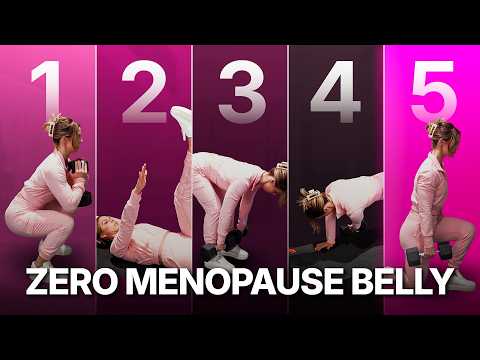
Menopause & Perimenopause Weight Loss
What is the best exercise for menopause belly fat?
The best exercise for menopause belly fat is progressive strength training, not more cardio or crunches. The show recommends compound moves like squats, deadlifts, presses, hip thrusts and lunges, done two to four times a week and paired with daily walking. You can't spot reduce belly fat. You lose it by building muscle.
Read the answer →

Menopause & Perimenopause Weight Loss
How do I lose visceral fat after menopause?
WarriorBabe's approach is to build muscle rather than chase the scale. Strength train consistently, swap long cardio for short sprint intervals, walk daily, and take an honest look at alcohol. Nikkiey says strength training can reduce visceral fat even when your weight doesn't change, so track your waist measurement, not just pounds.
Read the answer →

Menopause & Perimenopause Weight Loss
How many calories should I eat in menopause to lose weight?
On The WarriorBabe Show, Maggie Topham says most women over 40 who lift weights three to four days a week need roughly 1,700 to 2,200 calories a day, not 1,200 or less. Eating more, with enough protein, is what lets muscle rebuild and your metabolism recover so fat loss can actually happen.
Read the answer →

Menopause & Perimenopause Weight Loss
Do I need to do cardio to lose weight in menopause?
No. WarriorBabe's coaches say cardio isn't what drives fat loss in menopause, and leaning on it can backfire. They explain that too much cardio spikes cortisol and burns muscle, especially in a calorie deficit. What they recommend instead is strength training as the foundation, plus enough protein, daily walking and proper recovery.
Read the answer →
Watch or listen in full
More on this topic → 7 min
25-Minute Dumbbell Workout for Menopause Belly Fat
Video · Sep 24, 2025
 1 hr 1 min
How to Balance Hormones Naturally With Food and Exercise
With Jessica Suchan
 7 min
Best Exercises for Menopause Belly Fat After 50
Video · Apr 1, 2026