

From 1 episode and 1 video
Are scales that measure body fat accurate?
Answered by Nikkiey Stott · Updated
The short answer
No. Nikkiey says the body fat numbers on these scales are not accurate. If you use one consistently, though, the trend can still show whether you're progressing. For a truer reading she points to an InBody scan or a DEXA scan, plus progress pictures, measured the same way every time.
Hear it answered
Tap play to start right where it's answered. It keeps playing while you browse.

Nikkiey on why body fat scale numbers aren't accurate
Plays from 5:33 · Video: Menopause Workouts: Why Fewer Days and Straight Sets Help
Her 28% body fat reading, and how to still use the scale for trends
Plays from 5:51 · Video: Menopause Workouts: Why Fewer Days and Straight Sets Help
Better ways to track body fat when the scale doesn't tell the full story
Plays from 14:06 · Ep. 104: Why Isn't the Scale Moving When I Lift Weights?
InBody, DEXA, at-home options and how to measure consistently
Plays from 6:25 · Video: Menopause Workouts: Why Fewer Days and Straight Sets Help
The full answer
Nikkiey explains that at WarriorBabe, the stance on body fat scales is clear: the numbers and calculations they produce are not accurate. She shares that one of these scales once told her she was 28% body fat, and she knew too much to believe it. Still, she doesn't say to throw it out. If you step on it consistently while following the right program, the number moving up or down can tell you something, even if it isn't true to your actual body.
On Ep. 104, she adds the bigger point: a regular scale only tells you how heavy you are, not what you're made of. Two women can both weigh 150 pounds, one with more muscle and one with more fat. So when you're lifting and the scale won't budge, it may not be showing the progress you're actually making. It's the tool, not you.
When you want a clearer picture, Nikkiey mentions these options:
- Amazon Halo, which she found pretty accurate as an easy at-home method
- An InBody scan at your gym, if they have one, which she calls pretty accurate
- A DEXA scan, one of the most accurate ways to tell your body fat
- Calipers and progress pictures, which she calls more of a detective for solving what's happening in your body
Whatever you use, treat it like weighing yourself. Nikkiey says to measure first thing in the morning, on an empty stomach, after going to the bathroom, and to do it that way every single time. Testing in the afternoon will likely give you a number that doesn't line up with your last reading, which makes the comparison meaningless.
From WarriorBabe's coaches (how we write our answers). For education, not medical advice: talk to your doctor about your own health.
Women also ask
More on The Scale & Tracking Progress →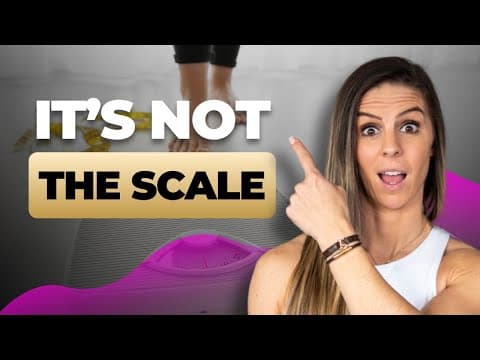
The Scale & Tracking Progress
Why do I weigh more the day after leg day?
The extra weight the day after leg day is water, not fat. Nikkiey explains that hard training creates tiny tears in your muscle fibers, and your body pulls water into those muscles to repair them. Legs are among your biggest muscles, so a temporary rise of a pound or two is normal.
Read the answer →

The Scale & Tracking Progress
Why isn't the scale moving when I'm strength training?
The scale often stalls with strength training because you can build muscle while losing fat at the same time, so your weight barely changes while your body composition does. Nikkiey explains that muscle is denser and takes up less space than fat. Water retention, glycogen, your cycle and hormonal shifts can also stall or spike the number.
Read the answer →

The Scale & Tracking Progress
What is the best time of day to weigh myself?
Weigh yourself in the morning, after a full night's sleep, after you've used the bathroom and before you eat or drink anything. Nikkiey says to keep the conditions the same each time, including what you wear, and never to weigh in at night, when the day's food, water, sodium and training can push the number up several pounds.
Read the answer →
The Scale & Tracking Progress
Why does the scale go up on days I under-eat?
Nikkiey explains that under-eating stresses your body, which she says can raise cortisol and make you hold on to water. It can also trigger metabolic adaptations that slow how you process food and drink. So the number climbs even though you ate less. It's a daily fluctuation driven by stress and water, not proof you're failing.
Read the answer →

The Scale & Tracking Progress
Why does the scale go up during a stressful week?
A stressful week usually pushes the scale up because of water, not fat. On Ep. 287 of The WarriorBabe Show, Nikkiey explains that stress correlates with water weight, and water shows up on the scale. The number can't tell fat from water, sodium, muscle or your period, so a jump isn't real fat gain.
Read the answer →

The Scale & Tracking Progress
How can I track progress without the scale?
Track the changes the scale can't show: waist and body measurements, side-by-side progress photos, how your clothes fit, and whether you're lifting more than two weeks ago. Nikkiey also watches energy, sleep, cravings, recovery and habits like hitting protein and showing up to train. The scale becomes supporting data, not the decision maker.
Read the answer →
Work out yours
All calculators →Watch or listen in full
More on this topic → 7 min
Menopause Workouts: Why Fewer Days and Straight Sets Help
Video · Feb 4, 2022
 28 min
Why Isn't the Scale Moving When I Lift Weights?
Episode 104 · Nov 17, 2023