

From 1 episode
What is leucine and why does it matter for building muscle?
Answered by Nikkiey Stott and her guests · Updated
The short answer
Leucine is the amino acid most responsible for switching on muscle protein synthesis. On Ep. 404, Nikkiey calls it the key that starts the engine: you need roughly 2 to 3 grams per meal to fully trigger the muscle-building response. Animal proteins, especially whey, are rich in it, while plant proteins are much lower.
Hear Nikkiey answer it
Tap play to start right where it's answered. It keeps playing while you browse.
Nikkiey explains leucine as the key that starts muscle protein synthesis
Plays from 12:38 · Ep. 404: 5 Protein Mistakes Holding Women Over 40 Back
Why the leucine threshold matters more with anabolic resistance after 40
Plays from 13:50 · Ep. 404: 5 Protein Mistakes Holding Women Over 40 Back
Anchoring every meal around a complete protein source
Plays from 11:40 · Ep. 404: 5 Protein Mistakes Holding Women Over 40 Back
The full answer
Nikkiey describes a leucine threshold. Below about 2 to 3 grams in a meal, the muscle-building signal is weak. Above it, the signal fires properly and you get the muscle protein synthesis you're training for. She points out that this is one reason whey protein produces such a strong muscle-building response compared with other sources.
This is where hitting your protein number can still fall short. Nikkiey explains that if most of your protein comes from plant sources, you can reach your daily gram target and still miss the leucine threshold at each meal. She adds that for women over 40, the muscle-building signal is already blunted by what she calls anabolic resistance, so you want that signal to fire as cleanly as possible every time you eat protein. If your results have stalled while your tracking app looks perfect, the issue may be the makeup of your meals, not your effort.
Her practical fixes from the same episode:
- Anchor every meal around a complete protein source, such as eggs, chicken, fish, Greek yogurt, cottage cheese, lean beef or whey.
- If you eat mostly plant-based, be more intentional. She notes that pairing two incomplete protein sources, like nuts and oatmeal, makes a complete protein.
Note that the pairing tip is about getting a complete amino acid profile. Nikkiey's point about leucine is separate: plant proteins are lower in it, so plant-based eaters need to pay closer attention to whether each meal is doing the job.
From Nikkiey Stott and WarriorBabe's coaching. For education, not medical advice: talk to your doctor about your own health.
Women also ask
More questions →
Protein for Women
How much protein do women over 40 need?
Most guidance on The WarriorBabe Show lands at about 1 gram of protein per pound of body weight per day for women over 40, based on goal weight if you have a lot to lose. Nikkiey says strength-training women may need 1.2 or even 1.3. Some episodes and guests cite 0.7 grams as the floor.
Read the answer →
Protein for Women
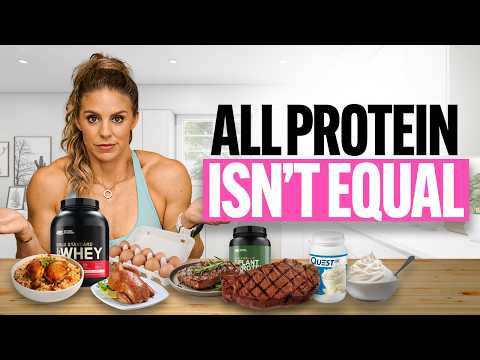
What is the difference between complete and incomplete protein?
A complete protein contains all nine essential amino acids, the ones your body can't make and must get from food. An incomplete protein is missing one or more. Complete sources are mostly animal-based, like chicken, eggs, fish, Greek yogurt and whey. Incomplete sources are mostly plant-based, like nuts, beans, lentils and oats.
Read the answer →
Protein for Women
Is it bad to eat most of my protein at dinner?
Nikkiey says yes, it works against you. Your body can only use roughly 30 to 40 grams of protein per meal to trigger muscle protein synthesis, so a big protein-heavy dinner triggers it once, while the excess is used for energy or excreted. Spreading the same total across four or more meals triggers it several times a day.
Read the answer →
Watch or listen in full
More on this topic → 20 min
5 Protein Mistakes Holding Women Over 40 Back
Episode 404 · Oct 12, 2026