

Chapters
In this video
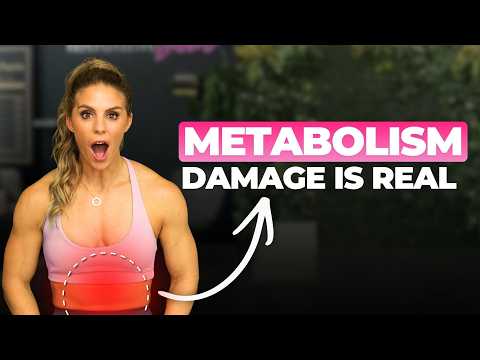
If you've been eating 1,100 to 1,300 calories for years and barely feel hungry anymore, Nikkiey Stott says to pay attention. In her view, a lack of hunger is a sign of an unhealthy metabolism, and it's something to fix before you start a cut or a muscle-building phase. She explains that your metabolism works within a range. It can become more efficient and hold on to calories, or less efficient and burn more of them, which is what you want.
From there, Nikkiey makes the case for strength training. Building muscle adds metabolically active tissue, and she shares how eight years of consistent lifting increased her own BMR so her body burns more at rest. She also explains why macros aren't another diet. They're a lifelong skill that teaches you portion sizes until you can look at a plate and know roughly what's on it.
She finishes with low carb and keto. You don't have to eliminate bread, pasta or rice, she says. You just need to understand how much of each food group fits your day, and in her view keto isn't sustainable long term.
Key takeaways
- Nikkiey sees a lack of hunger as a sign of an unhealthy metabolism, and says to fix it before starting any cut or muscle-building phase.
- Your metabolism can become more or less efficient with calories, and you want it less efficient so it burns more energy instead of conserving it.
- Eating around 1,100 to 1,300 calories is, in Nikkiey's words, just enough to survive. It doesn't cover the energy you need to work out and build muscle.
- Strength training and building muscle improve your metabolism because muscle is more metabolically active than fat tissue, which raises how much you burn at rest.
- Your BMR depends on your age, weight, height, sex and body composition, so it's different for everybody.
- Tracking macros is a skill, not a diet. Do it long enough and you'll recognize what three ounces of chicken or half a cup of rice looks like.
- You don't need to cut out bread, pasta or rice to get results. Learn the right portion sizes of each food group for your day instead.
- Nikkiey's view is that keto isn't sustainable, and that carbs and fats can both be used as fuel throughout your day while you still get results.
Questions answered
Is not feeling hungry a sign of a slow metabolism?
Nikkiey says that if you're not hungry, that's a sign of an unhealthy metabolism. She recommends fixing it before you go into any cut or try to build muscle.
Can building muscle increase my BMR?
Yes, according to Nikkiey. After eight years of strength training she has added significant muscle mass, and her BMR has increased because muscle is more metabolically active than fat tissue.
Is tracking macros just another diet?
Nikkiey says no. She describes macros as a lifestyle change and a skill set that teaches you portion sizes and how to understand what's on your plate for the rest of your life.
Do I have to give up bread, pasta and rice to lose weight?
Nikkiey says you don't have to eliminate them. You need to understand how much of that food group you should have in your day.
Is keto sustainable long term?
In Nikkiey's view, keto isn't sustainable. She says carbohydrates and fats can both be used as fuel throughout your day and still get you the results you want.
Full transcript
Nikkiey: Real quick, the only ask I could ever have of you guys is to help spread the word so we can help more women lose body fat, build muscle, reach their goals, and feel insanely confident. And the only way we can do that is if you rate, review, and share this podcast. So the single thing I ask you to do is leave a review. It will take you 10 seconds, and it will mean the absolute world to me and may change the world of someone else.
If you're not hungry, then that's a sign of an unhealthy metabolism. And so if you want to cut weight, or if you want to build muscle, you have to fix this process first, before you go into any type of cut, before putting your workouts where they need to be, all that stuff.
So our body, our metabolism, has this range of how many calories it can burn. It can make itself more efficient or less efficient with calories. When your body becomes less efficient with calories, it wastes more energy, it wastes more calories. You want to be less efficient. When it becomes more efficient, it conserves more calories, it holds on to more calories.
Macronutrients is not another diet, right? It's not like I'm jumping on the macronutrient train today. Macronutrients is a lifestyle change that will serve you for the rest of your life. It is a skill set that will serve you for the rest of your life. You are understanding food, you are understanding what is being placed on your plate, you are understanding portion sizes. You do this long enough, you're going to know what three ounces of chicken looks like, what half a cup of rice looks like. I guarantee it. I'm telling you this because I'm living proof. Eight years later, I can look at a plate of food and be like, that's protein, that's a carb, that's a fat, and probably give a ballpark estimate of how much it is in ounces and grams. So you're developing these habits, these routines, this understanding of food that encompasses an entire lifestyle change.
Metabolism is what a lot of people think is broken, because of the things you've maybe done or tried that have led your metabolism to slow down and not really work with you, and kind of work against you. People are eating 1,100, 1,200, 1,300 calories, and I'm going to get to that in a second. But that's just enough to basically help you survive. What about the other calories you need when you work out and you build strength, you build muscle? With people's metabolisms, it's like you're throwing spaghetti up against the wall and it's not sticking, and you're wondering why you're not getting results. We need to bring into the picture why strength training is so important, and why this concept of having more muscle on your body will improve your metabolism in so many ways. So if you guys want to eat more, you want to get the results, you want to decrease any health conditions or reduce the risk of them coming in the future, building muscle is your answer.
I started out my journey maybe being around that normal number for a BMR, which is like 1,100 calories, 1,300 calories. It's different for everybody. It's based on your age, your weight, your height, and your sex, and even getting down to your body composition and other things as well. For me, I don't have a measure of where my BMR was when I started out. But through the years of strength training, eight years now, doing the work, putting in the work, being consistent, making it my routine and making it my whole lifestyle, I have significantly added more muscle mass to my body. And so my BMR has increased, and my ability to burn more calories while my body is at rest is higher, because I have more metabolically active tissue on my body, which is more active than fat tissue.
There are so many different diets out there, and they have their own set of rules and restrictions. So, like you guys know, a low carb diet involves reducing the amount of carbohydrates that you consume. Typically, people know this diet as eliminating bread and pasta and rice. It's like, why do you have to eliminate that? You don't have to. You just need to understand what portion sizes you should have of this specific food group in your day, right?
And keto, this is another very popular diet. It's a very low carb, high fat diet that's designed to put your body in the state of ketosis, where it burns more fat for energy instead of glucose. But why? You can have carbohydrates. You can have these fuel sources used interchangeably throughout your day and still get the results that you want. Keto, guys, is not sustainable. Cool, if you want to do it for a couple of months, no hate towards it in that sense. If you want to do it, and you can sustain it, you can maintain it, and you're not going in and out of ketosis... if you want to do it for a couple of months...
So the single thing I ask you to do is leave a review. It will take you 10 seconds, and it will mean the absolute world to me and may change the world of someone else.
Up next
Everything → 37 min
How a 47-Year-Old Nurse Lost 21 Pounds by Eating More
Video · Jul 30, 2020
 7 min
Catabolic vs Anabolic: Why Undereating Stores Fat After 40
Video · Aug 19, 2021
 28 min
How to Fix Your Metabolism After Years of Dieting
Episode 39 · Apr 7, 2023
Best of Metabolism, Eating More & Reverse Dieting
All 211 → 28 min
Signs You're Not Eating Enough as a Woman Over 40
Episode 308 · Nov 3, 2025
 28 min
Reverse Dieting for Women Over 40: Do You Need One?
Episode 284 · Aug 11, 2025
 34 min
Is Metabolic Damage Real? How Long Metabolism Repair Takes
Episode 354 · Apr 20, 2026