

From 2 episodes
Can not eating enough cause bloating and constipation?
Answered by Nikkiey Stott and her guests · Updated
The short answer
Yes, according to The WarriorBabe Show. On Ep. 308, Nikkiey Stott explains that when you chronically under-eat, your body slows digestion to conserve energy, leaving you bloated, gassy and constipated even on clean food. On Ep. 70 she shares that eating only 14 grams of fat a day left her so constipated she ended up in the hospital.
Hear Nikkiey answer it
Tap play to start right where it's answered. It keeps playing while you browse.
Nikkiey on why bloating and constipation can mean you're not eating enough
Plays from 15:35 · Ep. 308: Signs You're Not Eating Enough as a Woman Over 40
Nikkiey on how too little fat left her hospitalized with constipation
Plays from 17:13 · Ep. 70: Can Restrictive Dieting and Overtraining Hurt Your Body?
How under-fueling affects gut bacteria, bloating and food sensitivities
Plays from 16:25 · Ep. 308: Signs You're Not Eating Enough as a Woman Over 40
The 900-calorie, 14-gram-fat diet that led to Nikkiey's hospital visit
Plays from 12:56 · Ep. 70: Can Restrictive Dieting and Overtraining Hurt Your Body?
The full answer
On Ep. 308, Nikkiey lists bloating, constipation and poor digestion as the third of five signs you're not eating enough. Many women assume it's just part of getting older or that they have gut issues, when they may simply not be eating enough to keep digestion moving. When you under-eat, your body tries to hold on to energy, and digestion is one of the first systems it turns down. Her analogy: a car low on gas doesn't shut off right away, but it runs rough. Your body can't break food down efficiently because it's busy in survival mode.
She adds a second layer. When you under-fuel, the healthy bacteria in your gut are affected and die off, which she says leads to even more bloating, more food sensitivities and more inflammation. The other signs she pairs with this include constant fatigue, irritability or anxiety, poor sleep and recovery, and stalled fat loss or gaining weight while eating less.
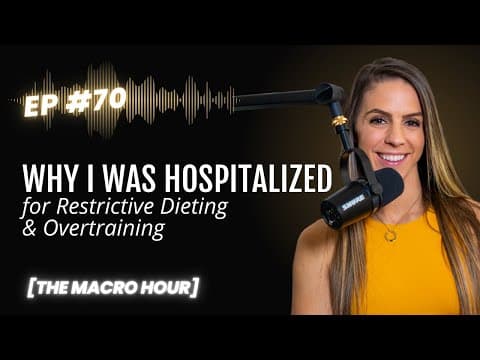
On Ep. 70, Nikkiey tells her own story. She ate about 900 calories and 14 grams of fat a day, roughly one tablespoon of olive oil, for up to 16 weeks. She was in so much pain from constipation that she went to the hospital, and she describes it as worse than a kidney stone. She explains that fat is a huge part of digestion and bowel health, and that around 60 to 70 grams a day is a good average for many people, though it depends on the individual.
The takeaway from both episodes: if you're bloated and backed up while eating very little, the plan may be the problem, not your body. If symptoms are severe or ongoing, work with your doctor.
From Nikkiey Stott and WarriorBabe's coaching. For education, not medical advice: talk to your doctor about your own health.
Women also ask
More questions →
Metabolism, Eating More & Reverse Dieting
How long does it take to repair your metabolism?
It depends on how adapted your metabolism is. Nikkiey's ranges: about six to 12 weeks for mild adaptation after a few months of moderate dieting, closer to three months after a year or more of restriction, and six months to a year after many years of chronic dieting. Your body's response sets the timeline, not a calendar.
Read the answer →
Metabolism, Eating More & Reverse Dieting
How do I know if I'm not eating enough?
Nikkiey points to five signs: constant fatigue, irritability or anxiety, bloating and constipation, poor sleep and recovery, and stalled fat loss or weight gain while eating less. Not feeling hungry on very little food is another red flag. The only way to know for sure is to weigh and track what you eat for a week.
Read the answer →

Metabolism, Eating More & Reverse Dieting
How do I eat more without gaining weight?
Raise your calories slowly instead of all at once. Nikkiey's approach is to track what you actually eat for a week to find your baseline, then add roughly 50 to 150 calories at a time, mostly from carbs and fats. Keep protein steady and watch sleep, mood, energy and hunger before each next increase.
Read the answer →
Watch or listen in full
More on this topic → 28 min
Signs You're Not Eating Enough as a Woman Over 40
Episode 308 · Nov 3, 2025
 29 min
Can Restrictive Dieting and Overtraining Hurt Your Body?
Episode 70 · Jun 21, 2023