

From 3 episodes and 2 videos
How many calories should I add each week when reverse dieting?
Answered by Nikkiey Stott and her guests · Updated
The short answer
Nikkiey suggests adding roughly 50 to 150 calories per week, after first tracking a full week to find your true starting intake. Bring protein up first, then carbs and fats. Hold each increase for one to two weeks while watching energy, sleep, mood, digestion and your weight trend before adding more.
Hear Nikkiey answer it
Tap play to start right where it's answered. It keeps playing while you browse.
Nikkiey on adding 100 to 150 calories a week and holding one to two weeks
Plays from 19:48 · Ep. 284: Reverse Dieting for Women Over 40: Do You Need One?

Nikkiey on her own reverse diet: 50 to 100 calories more each week
Plays from 1:55 · Video: One Year of Reverse Dieting After 1,200 Calories
An example jump from 1,200 to about 1,350 or 1,400 calories
Plays from 20:45 · Ep. 39: How to Fix Your Metabolism After Years of Dieting
Quick takeaways: protein first, then carbs and fats, and track biofeedback
Plays from 18:24 · Ep. 307: Why Your Reverse Diet Didn't Work and How Long It Takes
The full answer
The exact number depends on you. On Ep. 284, Nikkiey explains that the pace depends on how wrecked your metabolism is: some women can go a little harder, others need to go slower. The episodes give slightly different ranges:
- Ep. 307 and Ep. 284: about 100 to 150 calories per week, mostly from protein at first, then carbs and fats.
- Her own reverse diet (YouTube videos): 50 to 100 calories a week. She says it felt almost too small to matter, but the increases added up. She also admits one week she increased too fast and felt bloated and sluggish for days.
- Ep. 39: as a broad example, someone at 1,200 calories might move up 150 to 200 calories, to around 1,350 or 1,400, and stay there for a week or two.
Whatever the jump, the step before it matters. Track exactly what you eat for seven full days without trying to be good, so the increases start from your real baseline, not a guess. Then hold each new level for one to two weeks and stay consistent, because you can't judge how your body is responding if the numbers keep changing.
The decision to add more comes from biofeedback, not the scale alone. Nikkiey looks at energy, sleep, hunger, mood, strength in your workouts and digestion. If those improve and your weekly average weight holds steady, with normal fluctuations of a few pounds, you add more. If things feel off, you slow down. Use the extra energy to lift heavy and train with purpose.
This is a slow process by design. On Ep. 307 she says a reverse diet that seemed not to work usually wasn't held long enough, and if you've dieted for years you may need six to 12 months of repair before another deficit. Small, steady increases are not you failing to move fast enough. They are the plan.
From Nikkiey Stott and WarriorBabe's coaching. For education, not medical advice: talk to your doctor about your own health.
Women also ask
More questions →
Metabolism, Eating More & Reverse Dieting
How long does it take to repair your metabolism?
It depends on how adapted your metabolism is. Nikkiey's ranges: about six to 12 weeks for mild adaptation after a few months of moderate dieting, closer to three months after a year or more of restriction, and six months to a year after many years of chronic dieting. Your body's response sets the timeline, not a calendar.
Read the answer →

Metabolism, Eating More & Reverse Dieting
Will I gain weight when I start eating more?
Probably a little, and that's expected. Nikkiey explains that when you start eating more during a retrain or reverse diet, your weight will usually fluctuate about two to five pounds from water, glycogen, food volume and salt, not fat. If the gain keeps climbing or holds around five pounds, the increase was likely too fast.
Read the answer →

Metabolism, Eating More & Reverse Dieting
How do I know if I'm not eating enough?
Nikkiey points to five signs: constant fatigue, irritability or anxiety, bloating and constipation, poor sleep and recovery, and stalled fat loss or weight gain while eating less. Not feeling hungry on very little food is another red flag. The only way to know for sure is to weigh and track what you eat for a week.
Read the answer →
Watch or listen in full
More on this topic →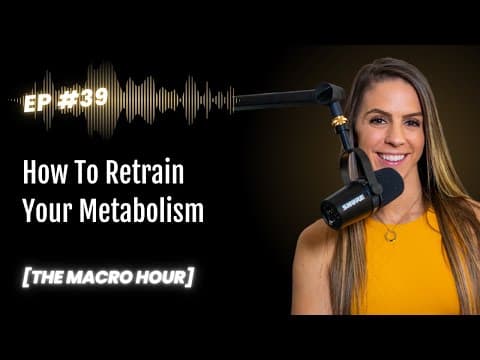 28 min
How to Fix Your Metabolism After Years of Dieting
Episode 39 · Apr 7, 2023
 28 min
Reverse Dieting for Women Over 40: Do You Need One?
Episode 284 · Aug 11, 2025
 6 min
One Year of Reverse Dieting After 1,200 Calories
Video · Feb 1, 2025