

Chapters
In this video
Leah is a physical therapist and clinic director in the Seattle area who treats patients about 45 hours a week. She had the degree, the gym and years of athletic training behind her, yet she kept putting everyone else first. After five years of online trainers that didn't stick, a failed New Year's push to do her first pull-up and a stretch of real burnout, she applied to WarriorBabe and committed to a full year.
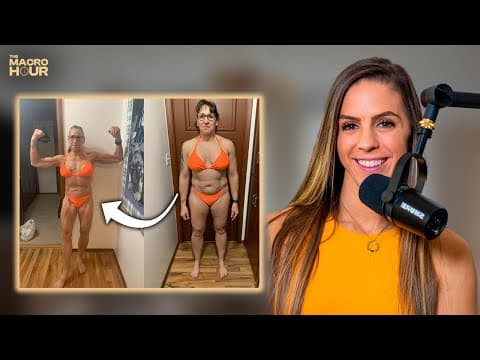
Her first week of tracking showed she was eating around 1,300 to 1,400 calories with no hunger cues at all. With her coach Adrian, she slowly worked up to about 2,050 calories at maintenance while still losing body fat, then started a build phase at just over 2,300 calories. The other big shift was doing less: three to four days of resistance training, rest days and sprint intervals instead of the long, five-to-six-day weeks she was used to. She lost 7 pounds and 3% body fat while doubling her intake, and she got her pull-up by her September birthday.
Nine months in, Leah talks about filling out her shoulders and glutes while tightening her belt, resting her full three minutes between sets in a gym full of men, and finally taking up space. Her advice for any woman who feels stuck is simple: be a little selfish, and ask for help. That isn't weakness, it's wisdom.
Key takeaways
- Before changing anything, track what you normally eat for a week; Leah discovered she was only eating 1,300 to 1,400 calories a day.
- Increase calories slowly; Leah's coach moved her up to 1,800 first, then 1,900, 2,000 and a maintenance of about 2,050 calories.
- Eating more woke up Leah's hunger cues, and her body fat kept dropping even as her calories went up.
- More training is not always better: three to four days of resistance training, rest days and short sprint intervals gave Leah better results than five to six days of long workouts.
- Muscle is broken down in the gym and built during recovery, so fuel and rest matter as much as the workout.
- In a build phase, gaining a little weight is a sign you're eating enough to fuel the muscle you're trying to put on.
- Take your full rest between sets with confidence; Leah rests three minutes and no longer rushes for anyone else in the gym.
- Asking for help is not weakness; Leah says women who give everything to others need to be willing to ask for what they need.
Questions answered
Can you lose body fat while eating more calories?
Leah went from about 1,400 calories to a maintenance of around 2,050, and her body weight and body fat kept going down. She lost 7 pounds and 3% body fat while roughly doubling her intake.
How many days a week should I lift weights to see results?
Leah had always trained five to six days a week, but her coach told her to slow down and take rest days. Three to four days of resistance training, with some sprint interval training instead of long workouts, gave her the results she wanted.
Why is recovery so important for building muscle?
As Leah explains, the breakdown happens in the gym and the build-up happens during recovery. Your body needs fuel and rest days to recover and build.
Why does my coach want me to gain weight in a build phase?
Leah's coach told her that gaining some weight ensures she's actually eating enough to fuel the muscle she's trying to put on. Otherwise, she said, Leah would just fall back to maintenance.
Is it selfish to put your own health first?
Leah says she joined WarriorBabe to be selfish, and everyone she talked to told her that prioritizing herself is not a selfish move. She believes asking for what you need is being wise, not weak.
Full transcript
Nikkiey: What did your journey look like before WarriorBabe?
Leah: Just nothing worked. I started to get desperate. That was just total burnout to a T.
Nikkiey: Let's talk about some of the top wins that you've had with your progress so far.
Leah: I've never had this confidence about my body that I'm actually proud to say, give me the tank tops, give me the shorts. I want to show off what I have done, and it's only been nine months.
Nikkiey: What's going on, everybody? Today I've got another amazing WarriorBabe. We were just catching up and getting to know each other before we hit record, and I'm super excited to dive into her story.
I have Leah here with us. She is a physical therapist who spent her career helping others get strong. Behind the scenes, she was struggling to put herself first, to prioritize herself. I know that so many of us women have been there, done that, and she was burnt out. She was underfeeding herself. She was stuck in the cycle of inconsistency. And she finally decided that she needed to make a change, and that's where we insert WarriorBabe. Now she's fueling her body. She's lifting heavier. She's feeling stronger mentally and physically more than ever. And now she's not just excited about getting older, she's thriving in her purpose. I'm excited for her to share her story. So Leah, welcome.
Leah: Oh, thank you so much, Nikkiey. Hearing it from you, I'm like, wow, that person sounds amazing. And to realize that's me, I'm like, this is awesome. This is great.
Nikkiey: I told you all we're in for a fun time. She's super cool. Yes, you are super cool. I know we were catching up a little bit before, but can you let the listeners know where you are from and what you do? I know I just said it, but what does your day-to-day look like with your clients?
Leah: Yeah. I'm currently residing in the Seattle, Washington area. I am a clinic director and physical therapist. So my day-to-day is a combination of treating patients for about 45 hours a week, and then working on the business with multiple staff PTs and other support staff, trying to build up my clinic and working with the community. So ultimately, my day-to-day is full-time PT, full-time practice director, just trying to reach as many people and heal as many people as possible.
Nikkiey: Wow. You just got even cooler. So ladies that are listening to this, Leah has a very demanding schedule when you break down what she focuses on day-to-day, yet she started to prioritize herself and put her health first. So I'm excited to unpack that. There are a lot of women who say, I'm just too busy to work out, too busy to eat. But Leah is about to say what's up about that.
All right. So let's talk about what your journey looked like before WarriorBabe. What were you struggling with physically and emotionally during that time?
Leah: Do you have the time? In all honesty, I grew up active my entire life. I was an athlete from the age of four, and a collegiate athlete with a couple of years under my belt. Then unfortunately, injuries and surgeries shortened my career. But I was always working out. I was always in the gym. I had the education to supposedly know what to do.
Then I said, okay, I have to get real about life. What am I going to go into? There was a part of me that wanted to become a strength and conditioning coach for collegiate athletes, and it turns out I don't really like collegiate athletes. So I pivoted and asked, what influenced me in my life and my journey at that time? And I thought, physical therapy. I had the opportunity to get some behind-the-scenes experience with that, and I was like, yes, this is what I'm passionate about. So not only did I take my active athletic career, I got to mix it with the medical side of things. I got my doctorate degree and have been practicing physical therapy for well over 10 years now.
I thought I had it all. I thought I had the knowledge. I do have a high level of knowledge on how the body is supposed to work. I have all of the experience in knowing how to lift, so it should come easy to me. And what I learned day in and day out, year in, year out, was that I was giving so much of myself to everyone else that I didn't know how to prioritize myself. Or I found every reason to put something else first, or say, no, okay, next week. Well, it didn't happen. This quarter, next quarter. That just became the limiting factor.
It was a lot of, yay, I'm in a groove, this is awesome, I'm totally going in the right direction, to, oh man, I am in a rut and I don't know how to get out of this. A lot of times they look the same, but they definitely treat the body differently, and it definitely makes the mental and emotional side a little bit harder to deal with. As I've gotten older, I've realized that's a lot harder to rebound from than it was before. So that's kind of where I was.
A lot of things shifted when the pandemic hit. It really affected us out here in the Pacific Northwest, and that brought a lot to light: what am I trying to do? Can I do this on my own? What do I need? Through those five years, from 2020 until now, I resorted to a lot of, can I find an online trainer? I outfitted my entire clinic with all the stuff I thought I needed to keep me motivated, to keep me on track, and nothing worked. Nothing worked at all. So that's where I started to get desperate, I guess you could say, where I started to say, okay, what do I need here?
Nikkiey: Yeah. So what led you to realize that something needed to change? What was that?
Leah: From a clinical standpoint, the population I was treating has changed over the past five years. As I went into my forties a little bit more, I noticed more and more complaints from women I was treating about not understanding their body, and going through that: is this perimenopause? Is this menopause? How do I treat these patients better?
Late last year, I had this idea. I was like, listen, I need a better community around here. I want to start offering the ability for a small group of women to get together, even if it's coming in on Saturdays. I said I want women between the ages of 45 and 60, that spectrum. Maybe I can get a small group of women who have been through physical therapy to come together, collaborate and have a community amongst themselves.
As that idea developed, I thought, well, I've got to educate myself. If I'm going to lead these women in a certain way, I need to know what to offer them. And then I started to learn what I don't know, and that was a lot. I started reaching out to physicians in the area to say, can you help me? Can we collaborate? Can we offer something to women around here? And it was amazing how oblivious they were to what women needed and wanted. Nobody could give me that support.
So I thought, okay, there's got to be a better resource, a better outlet to get this information. I started looking online, and I think it was on Instagram that I came across WarriorBabe. I was like, hang on. This is hitting the population I want. This is pretty awesome. Let me explore what they're doing. And then I thought, okay, if I'm going to teach it and preach it, I've got to do it for myself.
I wasn't quite ready to do it yet. So in January, I gave myself a New Year's resolution that by my next birthday, which is in September, I wanted to be able to do a pull-up. Throughout all of my life, with all of my athletics, with everything, I've never had the strength to do a pull-up. So I was like, okay, January, I'm going to set a plan up, I'm going to try, I'm going to get this done. And January was a failure. I couldn't stay consistent.
It was probably the worst health experience I've ever had. I was listening to your episode about updating life and things like that, and I was like, girl, I got you. That is so how I felt during that time, even to the point that I was rethinking my career. And I thought, if I can't do this on my own, I've got to take that leap and try. So I submitted the application to WarriorBabe.
What was amazing, even compared to the previous four years of working with online trainers, was how responsive your team was. I was like, hang on, they're going to respond in 24 hours? This is a legit thing. This is going to hold me accountable. So I went into it. I had the beginner interview, and then they said, just know that this is a year-long commitment. My jaw dropped, and I thought, hang on, can I do this? And then I thought, nothing else has ever worked. If this isn't going to do it, nothing else is going to do it. And it was the best decision I could have ever made. Now I don't even think about it.
Nikkiey: Love that. I love that you feel that way about your journey so far. I definitely want to unpack what your initial experience was when you first came in, outside of us responding in 24 hours, like what the first couple of weeks looked like and getting used to our program. But I want to backtrack a little bit to the goal that you set for yourself, doing one pull-up by your birthday in September. Really quick, did we get there? Did you get to do one in September?
Leah: Yes.
Nikkiey: Yay, let's go. I love that. But back in January, you were struggling to get it on your own. What did that reveal to you about where you were with your strength at that point? I've had a couple of women who are physical therapists. You take care of patients on a daily basis, making them stronger. So was it kind of like a mirror, where what you see in your patients, you were experiencing for yourself? Like, I'm actually not as strong as I want to be? What did that reveal for you when you couldn't do a pull-up in January?
Leah: In all honesty, I think it stems back 20 or 25 years. I've never been one of those people who needs the scale to look like a certain thing. But I was raised under the circumstances of, hey, Leah, genetically you're probably never going to look like some of your friends. You're never going to have this body or this physique. I always called myself a little teapot, short and stout.
There was always some good strength, but there was never a physical presentation I was proud to show off. It was, the more you can cover up, the better off you're going to be. You're always going to be cautious of what you eat. You're always going to be conscientious of what you put in your body, because unfortunately, your body is just not going to be the thing you're proud of. So I always worked out because I knew I had to, because the alternative, from genetics, was that I would be overweight, obese for that matter.
So being able to do a pull-up was never on my spectrum of things, because I was always told it's most likely not going to happen. Training-wise, it was never about having a goal to accomplish. It was, you should work out because if you don't, you're going to look like this half of your family. So it wasn't necessarily a reflection of, I'm not as strong as I want to be. I was always just settling to maintain, to keep this up because I had to, not always because I wanted to, but because I didn't want to face what the alternative could hypothetically be.
Nikkiey: That makes total sense. I hear you. You mentioned a couple of minutes ago that you were in a dark place before WarriorBabe, and you were considering a major life change, questioning whether this job was even meant for you. What did that period feel like for you at that time?
Leah: Oh man, that was just total burnout to a T. You were a nurse, you've worked in healthcare, and over the past five years it has only gotten worse as far as the demand. It was give everything, take nothing. It was constant. I kind of say it's like being a chameleon. You're adapting to everything around you. You're putting on different faces for everyone and everything. It was becoming very repetitive, very draining.
And getting older, there's been minimal time to actually take care of myself internally, even going to my own doctor's appointments. I was like, hang on, I've been doing this for so long, it should be a routine. So why am I going home with nothing more but tears? Things that weren't common for my personality, like becoming more of a recluse, not wanting to socialize as much, working for the weekend. I've never worked for the weekend. I love what I do. But I was like, the weekend cannot get here fast enough. And then when the weekend came, I did not want to leave my house because I did not want to have to people anymore.
During that time, I went through a period of trying to get back into mental health therapy, and being the people pleaser, the giver, I felt like I was therapizing my therapist. I was constantly trying to engage with her, and I'm like, no, this is for me. But I could not turn off that side of things. It was constantly making sure everybody else was okay, and I didn't know how to change it.
Nikkiey: Interesting. So was there a moment when you were like, I need this for me, I need to do this?
Leah: Yes, 1000%. Because again, what I do for a job, this is me. I would do it if I didn't get paid anything. I want to do it until I'm 73. I want to do this forever. But the second I started to feel like this isn't working, I was like, hang on, I've got to flip the script.
I've said, I'm doing WarriorBabe because I want to be selfish. And everyone I've talked to says, that's not a selfish move. Why do you think you're being selfish? And I'm like, well, because I'm doing it for me. And they're like, but that's not being selfish. But yes, there absolutely was a moment: if I don't make a change for me, if I don't start prioritizing me, then I don't know where I'm going to be six months or a year from now.
Nikkiey: We're going to put a pin there and circle back to that. Now I want to lead into this: you saw us on Instagram. Was there anything that I was saying in particular that caught your eye, or what was resonating with you the most?
Leah: The crazy thing is, it was actually that it was woman-specific and 45 and up. And I'm like, I know I'm under that, but this is who I want to work with as far as patient clientele. So I was like, let's just see if they accept me. Honestly, it was as simple as that. Initially, that is all I needed to say, this is different from every other trainer or coach I've ever worked with.
Nikkiey: Love that. And I also love what gave you confidence in your signup experience, what you mentioned earlier, that we were responsive within 24 hours compared to other programs you tried. So the next thing I want to talk about is the nutrition aspect, because you said it was very humbling, almost embarrassing, to realize that you were eating around 1,400 calories. In the first weeks of joining WarriorBabe, what did that process look like for you?
Leah: That goes back to the intro interview. I forget who I was talking to, but it was an awesome conversation, and she made this joke like, yeah, a lot of women, when they start, think they can survive off of 1,200, 1,400 calories. And I chuckled. I was like, why would any grown individual think they can do that?
So they said, okay, the first thing you're going to do is get on MyFitnessPal and track for a week. Don't change anything. And day in and day out, I was like, oh no, I'm at 1,400. Oh no, I only got 1,300. Every day I was like, I've got to get more, and that was without changing anything. I was like, holy cow. And no hunger cues, nothing. I treat between 14 and 16 patients a day. It is go, go, go, grab something on the run. When I started to track, I was like, oh my gosh, no wonder I'm feeling so tired. So that was very humbling, to be like, yep, check, I'm one of those. I'm part of that statistic.
Then I started working with my coach, Adrian, who is amazing. She said, okay, we've got to bump that up. It's going to be a slow process, but we've got to get that going. In all honesty, we tried to get up to 1,800 first, and it was a struggle. I always joked that this is literally a part-time job: okay, where do we go here? How do we balance this? How do we get the proper macros to balance out? It was a lot of hard work. Put me in the gym all day and I can knock that out. I love being told what to do there. But the fuel consumption, as I call it, completely changed how my brain worked and what my habits were.
Nikkiey: So how long did you do a reverse? Did you get to 1,800?
Leah: Yeah, I got to 1,800. Here's the thing. I started eating more, and all of a sudden the hunger started coming, and I was still losing weight. All of a sudden you wake the metabolism up, and I'm like, buddy. So I got up to 1,900, 1,950, 2,000. I think maintenance was around 2,050.
Nikkiey: And you were losing weight.
Leah: Body weight was still going down, and that was not a goal. Body fat was continuing to go down. And I'm starting to see, even as a physical therapist, looking at my arms, I'm like, I didn't know you're supposed to have a muscle there. That's pretty awesome. Just these small definitions where I'm like, this is what it could look like on me. It was an amazing thing. So my maintenance calories sat around 2,050.
Nikkiey: I love that. Would you say those were some early wins, or were there any additional aha moments that helped shift your focus and your momentum when you first joined, along with eating more?
Leah: Yes. It was, actually, Leah, you have to do less.
Nikkiey: What does that mean?
Leah: Throughout life it was collegiate sports, training six days a week and playing two to three times a week, doing two-a-days. Even working with other trainers, they were programming five to six days of resistance and cardio work a week. And I was supposed to do that on top of working 10 to 11 hours a day. It was a lot of zone 2 cardio, and we see how beneficial that is as we get older.
I remember early on telling Adrian, I need to do more. I don't feel like I'm doing enough. And she said, no, slow it down. You need your rest days. Put the reins on a little. I don't need you to do more. Or if you want to do more, we're going to transition into incorporating some sprint interval training. You're not going to be doing these prolonged workouts. Don't think lifting five days a week is going to be necessary.
That's where I really had to come to terms with the fact that doing three to four days of resistance training was actually going to give me the results I wanted. That was really, really hard to come to terms with, because it's always been more is better. You've got to keep that balance of energy in and energy out. And it was like, no, you've got to give your body the fuel to recover.
Another thing is really understanding that the breakdown occurs in the gym, and the build-up occurs during the recovery time. Even as a physical therapist, that's all I tell my patients, but it needs to be emphasized more. So that was definitely a mind-blowing, eye-opening moment. The recovery is just as important.
Nikkiey: I love that. Yes, less is more. And I love that it was an aha moment early on and you were able to switch gears pretty quickly to make that work for you in the program. Can you share a little bit about how Coach Adrian helped guide you and what her support has meant to you? What's it been like for you to work with a coach?
Leah: It's a blessing. You guys match people up really well with coaches. I don't know what your intake process is, but you definitely hit the nail on the head with Adrian being mine. We are of a similar age and have had a similar journey in life. I mentioned that I did a little bit of mental health therapy early on, and the reality is, I think this is better therapy for me.
Coach Adrian has acted as a physical coach, programming and doing what I need to push me, but also holding me accountable. She has been a mentor, both from a work standpoint and a life standpoint. And she has been an ear for me when I say, I don't know if I can do this, or I'm screwing this up. And she's like, Leah, stop being a type A personality. You are doing fine. It is not going to be perfect every week. Get over that. This is a long-term thing.
The relationship built really quickly. The way she approached me was some tough love sometimes, but she was also a cheerleader I didn't know I needed in so many realms. That allowed the week-to-week motivation, and then in those monthly check-ins, whenever I was feeling like I was getting back into one of those ruts, wondering where the groove is, she just knows exactly where to pivot or how to support me so I'm like, oh yeah, I got this. I can do this.
Nikkiey: Oh, I love that. The perfect blend of tough love and cheerleader. That's awesome. So let's talk about you since joining WarriorBabe. Where are you now? Let's talk about some of the top wins you've had with your progress so far.
Leah: I'm a total numbers person, but I'm not going to go objective here. It truly is more subjective. We mentioned I found my maintenance calories, and I'm like, cool, I understand what that is. Far from 1,400. And I've actually started a build phase. I'm six weeks into a build phase, and this is set up for the next year, because I signed on for another two years of this. Why wouldn't I?
I would say the wins ultimately are, one, learning how my body works. I now want to push it to the limits to understand what more it can do, especially while I'm still at an age where I have a little more availability to make those changes. Hormones can still be managed where I am right now. So I want to do this now. Because again, I've always been told, you're just never going to look that way. And I'm like, do you see what I did in three months and six months, and now going into nine months? I want to go through this build. I think it's an amazing program Coach Adrian has set up, and I'm thrilled about it. I do have to eat more, so that's a thing.
Nikkiey: Tell me about that.
Leah: Legit, I'm just over 2,300 calories that I have to eat. The hard part is my schedule. I get more hungry throughout the day, and I'm like, I need to go, I need my snack. I'm messaging my team, I'm messaging my staff, saying, I'm hungry, I need somebody to help me so I can take in some food real quick. This was never how it was in the past. I'm actually being told to double my intake.
Nikkiey: I know, that's crazy. And let's talk objectively really quick, because you lost seven pounds and dropped 3% body fat, and then you doubled your intake, right?
Leah: And then I doubled my intake. And even now, Coach Adrian is like, Leah, you need to gain some weight, because that ensures you're actually taking in enough calories to fuel the muscles you're trying to put on. And I'm like, okay, I've gained one pound. And she's like, you're going to fall back to maintenance. You've got to be aggressive with this.
But it's more the subjective component. I have never filled out my pants through the backside, the butt area, as well as I have now. But the waist, I don't have enough belts. I'm putting notches in my belts to keep the waist cinched. It's never been like this. I've never had shoulders that fill out the shoulder region, where I'm like, oh, I love that, I can feel my shirt being a little tighter. I've always worn my clothes a little baggier, and now I want to go a size smaller because I want to show off what I've actually built. Right now it's like 50 degrees in Washington, so it's not the most conducive time, but I've never had this confidence about my body where I'm actually proud to say, give me the tank tops, give me the shorts. I want to show off what I have done. And it's only been nine months.
Nikkiey: Wow. That's incredible. You're a rock star, Leah.
Leah: It's you guys. What your program is capable of doing is just outrageous. Every woman should take the chance, take the opportunity. It's huge. It is so amazing what WarriorBabe promotes, what it teaches, not what it preaches, but what it teaches and then what it supports. It's astounding what we are truly capable of doing when we have the right guidance.
Nikkiey: My favorite part about this is your words right there, that you're learning exactly how your body operates. You're learning cues, you're hearing hunger cues. You're learning what your body needs as you go through the build. You're aware that you need to eat periodically throughout the day so you can get your 2,300 calories in and really go into this build aggressively and take it on head on. I love it.
And what you said, we're not preaching something. We're teaching you this, so you know how to listen to your body and understand what it's trying to tell you. But it's also so unique to you. You're learning all of this by eating double your previous intake and experiencing the results you're experiencing, both objectively and subjectively, at your own pace. This has been nine months for you, and you're taking in everything you're learning, which is so cool. We're teaching you this methodology for you individually by working with your journey.
So back to the question I put a pin in. If you had never made this change, where do you think you would be right now?
Leah: Honestly, it's kind of scary to think about, and I know you can relate. Something pretty awesome about the beginning experience was getting the hormone panel done. And girl, I got you, I understand everything you've shared about yours. When I had mine done, the things it exposed, I was like, they must have screwed this up. That can't be me, because I didn't have the outward physical side of things. I'm like, I don't have that. I'm not that bad.
But it was the estrogen, testosterone, DHEA. My cortisol would start low and end up high at the end of the day, and they said it's got to be the opposite direction. Everything was out of whack. And that was the epiphany. Everything I had felt, getting that understanding from an internal standpoint, said: it's not me, but it's me. We can work around that.
That, leading into the coaching, the support and the accountability, has made me feel like I have a purpose because I have a presence. I've always been very confident in my job, and I know how to do my job really, really well. To compare and contrast with your journey, you've battled with the masculine versus feminine energy, and you've found things that I feel have made you more whole, fine in your entirety. That's amazing. And listening to your journey, I think about how WarriorBabe has brought a wholeness to me. I knew I was missing something, but I didn't know what I was missing.
It fulfilled the confidence that, for years, I didn't feel. I didn't feel like I was taking up space, and I didn't know why. I knew I could do a good job with certain things, but being such a people pleaser, I stayed passive. Now, being stronger and being proud of what this external physique looks like, it carries into that internal mentality to say, no, you don't have to be passive and sit on the sidelines and let the world walk all over you. I have this purpose. Look at me. I know what I'm capable of. Don't get in my way.
It's even present when I go to the gym to work out. I have my program, and when I go to the gym it's like a nine-to-one ratio of men to women. I'll be on whatever machines, and I am so confident sitting and giving myself my three-minute rest time between sets. I don't care if somebody else is looking at me saying, what are you doing? I have purpose to be there because I'm doing this for my body. Sure, you're on your journey doing your workout, but I have purpose. Don't try to bully me out of doing something I need to do. I'm not going to rush life because it's going to make it more convenient for you, or bend over backwards because it's going to make it more convenient for someone else.
So when you ask where I would be, that's a very broad question, and the answer is going to be very broad. But I know where I am now, and I'm thrilled with where I am now and so excited about the future.
Nikkiey: That's such a powerful response. It's like you take up the space. We're not meant to shrink or be small. We're meant to take up space. And you're doing it with purpose and intention. You have a reason to be in the room. You have a reason to show up for yourself. That is super powerful.
How has it impacted your work life, being a PT and clinic director? You mentioned at the beginning that you wanted to pivot more of the practice toward helping peri- to postmenopausal women. How is that now, having this knowledge and these tools and resources? You said you needed to be the one to experience it before you could actually teach it. Is it coming full circle for you?
Leah: Not entirely, only because I always want to be really good and really knowledgeable about something before I pass it on. It has definitely given me more confidence to speak about my experience, to say, this is why I want you to do it. Look at what I have done. These are things you can have the opportunity to do too.
As far as full circle, this is still the early side of the marathon I'm running. I know this is laying the foundation for great things to come, but it takes time for those great things to occur. How I really look at it is, in three years, five years, 10 years, this is how I want to reshape or pivot how I practice. In nine months alone, no, this is still for me. But I speak with more confidence.
For where my professional career goes, this is laying the most solid foundation for anything I'm going to do in the future. It's giving me more personal experience. It's allowing me to physically get through a certain phase, which is leading me to study and research other elements, which is going to lead to me getting other certifications, so that I truly have all the backing I need to provide my patients with the best experience and as much research knowledge as possible. As opposed to, well, I think you can, or you might be able to, I want it to be: these are the things that have been shown to work. This is how we're going to do it.
Nikkiey: That's incredible. And what I think is so cool about your journey, for you personally, is that you're setting yourself up to go through menopause in the strongest way possible. Experiencing the symptoms is going to be so much easier than for someone who isn't moving their body, isn't strength training, isn't eating right, is under-eating. You're doing all of the right things.
Leah: Yeah. And that's the thing about WarriorBabe. It is so beneficial to women as they get older to realize that what they have isn't what they're stuck with. But I wish women, even as they're approaching 40, in their late thirties, would start looking into things like this more. Why not set yourself up for success, or at least tolerance, for what we're all about to go through, compared to saying, okay, this is what we're doomed with, because we don't educate people enough about it?
That's where I am. I'm talking to more and more of my patients of a similar age and saying, don't wait. It's inevitable, it's going to happen, but don't wait. Start the changes now. Start to educate yourself now, because this is when it's going to be easier to brace for, and it's going to make the next 20 to 30 years so much better.
Nikkiey: Oh, I love that. So I have one question as we wrap up this interview together. What is one piece of advice you would give someone who feels stuck, maybe in the same way you were stuck, with the inconsistency, or fearing food, or unsure how to take that first step?
Leah: I would ultimately say, one, be selfish. But especially considering the clientele you guys appeal to, you have strong women within your program, and that's amazing. I think we as women need to be willing to be more vulnerable and ask for help. That was something that, especially in my profession, was humbling to say: I can't do it on my own. Am I going to pay for somebody else to do this? But have a support system. Seek out the help, because there are people out there to help you.
Every woman is giving herself to everyone else, and rarely do we ask for what we need. Starting something like this is acknowledging that it's not that you're weak. You are being wise to ask for what you need. And this is the perfect platform to do it on. This is going to help you mentally, physically, emotionally, spiritually. That's how you're going to find your wholeness. It's just a matter of which one is lacking at this time. So I would say, don't be afraid to ask for help. This may be a different form of help than you've sought out before, but it can be so impactful.
Nikkiey: I love that. That's such a wise response, and I think you're so spot on. So many women have a hard time asking for help, and yet we're silently struggling. It's easier said than done, but it's really that simple to say, I need help, and then see the reaction. People will want to give help. I love that response. It's so heartfelt.
To any woman listening right now, let Leah's story be a reminder that knowledge isn't necessarily the missing piece. She had all the tools and all the knowledge. She knew all the things. What I learned from you in this interview is that ownership is really the missing piece: taking ownership for you, being selfish, really taking the action and asking for the help. And it's not too late to reclaim your strength, your purpose, your confidence. Whether you're a health professional like Leah, or a mom, or someone who's always putting others first, this journey is yours to take, and yours to finally put yourself first. Leah, thank you for being here and for sharing your story. I know it's really going to resonate with a lot of women.
Leah: This is awesome. And thank you for everything you do. It has been very impactful.
Nikkiey: Thank you for trusting in us. Did we deliver on the promise we made you at the beginning?
Leah: A hundred percent. Like I said, I've already signed up for two more years, and I'm just waiting for you to roll out more. I'll do another two years.
Nikkiey: Coach Adrian's going to be with you. You're going to be here forever.
Leah: I've threatened her with that already.
Nikkiey: I love that. All right, Leah, thank you.
Leah: Absolutely.
Up next
Everything → 26 min
Eating More and Less Cardio: A Body Recomp at 47
Episode 394 · Sep 7, 2026
 39 min
Can You Change Your Body in Your 60s? Laura's Story
Episode 230 · Feb 3, 2025
 46 min
Why Eating More Helped Me Lose Fat After 40
Episode 355 · Apr 24, 2026
Best of WarriorBabe Transformation Stories
All 113 → 43 min
Eating More and Getting Leaner at 54: Jodi's Story
Episode 256 · May 5, 2025
 29 min
Gained Weight at 40 Despite Working Out? What Worked
Episode 331 · Jan 26, 2026
 17 min
How to Build Muscle and Lose Fat in Your 50s and 60s
Episode 169 · Jul 1, 2024