

Chapters
In this video
Kelly is 61, lives in North Carolina and spends her workday sitting as a bank reconciliation specialist. Restrictive dieting worked for her before menopause. After it, the weight came on and stayed, through low calorie, low carb, walking and everything else she tried. At one point she was eating under 800 calories a day and was still stuck. Then a fall down the stairs broke her tibial plateau, and the surgery left her left thigh nearly two inches smaller than her right and left her afraid to lift at all.
In this WarriorBabe member story, Kelly explains what changed once she started working with her coach, April. She began with mobility, band work and bodyweight moves, and lifted no more than 10 pounds for the first few months. She didn't squat for months. She started eating more than she ever had, learned how macros let regular food fit her day, and took her measurements every week. Six months in, she can squat nearly to the floor, do lunges without holding on, glute bridge 100 pounds and hold push-ups on her toes for a full minute.
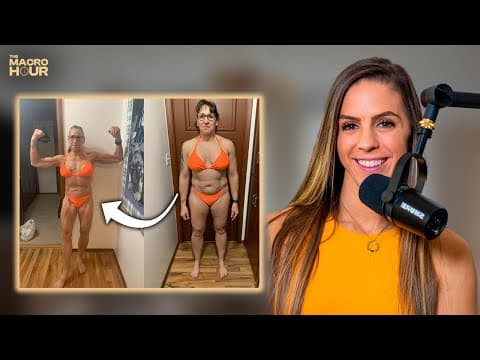
The scale barely moved, but she lost over four inches from her waist. Side-by-side photos showed her the progress the scale didn't. Kelly is now in a build phase and no longer cares whether she gains a few pounds, because she knows it means muscle. If an injury or menopause has convinced you your body is done changing, her story is worth your time.
Key takeaways
- Eating 1,200 calories a day, and eventually under 800, didn't change Kelly's body after menopause; she later learned she wasn't eating enough protein.
- After her knee surgery, Kelly's coach started her with mobility work, bands and slow bodyweight movements, and she didn't lift more than 10 pounds in the first few months.
- Squats came back only after months of building strength, once Kelly told her coach she felt ready.
- Kelly's coach told her the process would take a year or more, because years of habits don't fix overnight, and knowing that made it okay not to see results right away.
- Learning macros showed Kelly she can eat regular food, and even fit in a glass of wine, instead of dieting on lettuce and chicken.
- Kelly took her measurements every week and lost over four inches from her waist even though she didn't lose much weight, and some measurements went up from muscle growth.
- Side-by-side progress photos from three months apart helped Kelly stop relying on the scale.
- Kelly is now in a build phase, eating more, and expects a few pounds on the scale because she is also putting on muscle.
Questions answered
Can you rebuild leg strength after knee surgery in your 60s?
Kelly broke her tibial plateau and had a plate and seven screws put in. Nearly two years later her left leg was still an inch and a half smaller than her right. By working up slowly with her coach, starting with mobility and light weights, she now squats almost to the floor and does lunges without holding onto anything at 61.
How do you start strength training when you're afraid of re-injury?
Kelly's coach went slowly, using band work, bodyweight exercises and slow movements, and Kelly didn't pick up more than 10 pounds in the first few months. Kelly says she needed that to believe she could build the strength back up, and she only started squats once she told her coach she was ready.
Why didn't a 1,200-calorie diet work after menopause?
Kelly was told to eat 1,200 calories a day, record everything, skip weights and just walk. She eventually got down to under 800 calories and felt angry and hungry, without real results. She later found she wasn't eating enough protein, and with WarriorBabe she eats more than she ever has.
Can your body change if the scale isn't moving?
Kelly says she hasn't lost a lot of weight, but her body changes have been dramatic, including over four inches off her waist. Weekly measurements and side-by-side photos from her coach showed her it was working when the scale didn't.
How long does it take to see results after menopause?
Kelly's coach told her it would take a year or more, because it took years to get her body to where it was. Kelly says knowing that made it okay not to see results right away, even though she did see some early on.
Full transcript
Kelly: I didn't want to go to the beach. I didn't want to put a bathing suit on and have people see me anymore. It's tough. It's really tough.
Host: Menopause is a killer.
Kelly: It definitely is.
Host: What's going on, everybody? Today we have WarriorBabe Kelly here with us. Kelly had spent years trying to control her weight, but after menopause, nothing seemed to work. Then she had a major knee injury that left her struggling with mobility, muscle loss and fear of re-injuring it. She felt like her body was working against her no matter what she tried. Nothing was changing until she found WarriorBabe. Now she's stronger, she's more confident, and she's moving through life pain-free. She's lifting, she's squatting, and she's pushing herself harder than ever before, all while completely transforming her body composition. Kelly, welcome.
Kelly: Hi, thank you.
Host: Can you tell us where you're from, what you do for work, and share how old you are?
Kelly: I currently live in North Carolina. I am a bank reconciliation specialist, so I do a lot of sitting, and I am 61 years old.
Host: 61 years young.
Kelly: Okay, young.
Host: All right, so let's talk about where you were before WarriorBabe. What was your health and fitness situation like before you found us?
Kelly: In my olden days, I did a lot of restrictive dieting, limiting what I ate. When I was younger, pre-menopause, it worked. It seemed to do what I needed, or so I thought. Menopause came. The weight came on. It would not go away, no matter what I did. Like you said, I tried them all. I tried extreme low calorie. I tried low carb. I tried walking. I tried anything I could.
And after my injury, I was afraid to lift. So I wasn't lifting any weights because I was afraid it wasn't going to do any good. Come to find out, I wasn't eating enough protein. And I happened to stumble upon your video on, I think it was Instagram. I remember saving it, and I remember thinking about it for a while and thinking, God, should I do this? Because it just sounds too good to be true. It just can't be true.
And I finally did it. I finally filled out the form, and I haven't looked back since. It's amazing. I eat more than I've ever eaten. I'm eating healthier, but I'm eating more. And with my coach helping me along the way, understanding some of my initial movement restrictions, she's gotten me strong enough that those restrictions are now gone, which is huge for me.
I never thought I would squat again. The fact that I can is just amazing to me. I'm in heaven. I love getting up every morning. I love working out. I feel so much better. I feel muscle. I didn't realize I didn't have muscles before.
Host: Oh, I love that.
Kelly: And I didn't realize that you can be skinny fat, if that makes sense, where you just don't have any muscle tone, but you're scrawny. I was scrawny. I didn't look good. I didn't feel good.
Host: You mentioned that you had tried so many different programs, like low carb, keto, low calories, whatever was out there. What was the most frustrating part about not seeing results while you were trying to follow those programs?
Kelly: I starved myself when I was doing the calorie counting. I don't know if we're allowed to name different programs.
Host: Totally. Go for it.
Kelly: They told me 1,200 calories a day is what you needed, and to record everything you ate, not to lift weights, just to walk. And I did all of that, and it didn't work. I got myself down to eating under 800 calories a day. And I came from a heavy family. I did not want to turn into my mom and dad. I watched both of them struggle to move and get around, and I did not want that. And as much as watching my calories may have lost a few pounds, I didn't feel good. I was angry. I was hangry. I didn't like myself. I didn't like the direction I was going, and WarriorBabe has changed that dramatically.
Host: That's amazing. I'm so happy to hear that. And it's so cool to hear your accomplishments, and I definitely want to unpack them more, because you're doing so many good things and your body is transformed.
I want to take it back to the injury. There are so many women I've talked to who have had hip replacements or knee surgery or knee replacements, and like you mentioned, they're afraid of re-injuring it or afraid they're not going to recover. How did it feel to lose the mobility and lose the strength? Did you ever feel like you might not recover?
Kelly: I absolutely felt like I would not recover. I broke my tibial plateau. I fell down steps. I was non-weight bearing for 12 weeks.
Host: That's a gnarly fall.
Kelly: I had surgery. I had a plate and seven screws put in. And when I finally started therapy seven weeks in, my left thigh was almost two inches smaller than my right. Until I started WarriorBabe at the end of August or beginning of September of last year, that leg was still an inch and a half smaller. I could not get the muscle back.
Going up and down steps was a challenge. I live in a house on pylons. I have 19 steps, and I go up and down every day, multiple times a day. My husband would take the dog down the steps for me for fear that the dog would pull me, because I didn't have the strength. I couldn't do it. Sitting all day and then getting up and walking was agony. And I was afraid. I was afraid I was going to have that old arthritic knee and be on a walker or crutches for the rest of my life, or until I got immobile and was in a wheelchair.
Host: What made you decide that you weren't going to accept that as your reality?
Kelly: Knowing that I'm still young enough and I should be able to move. My coach slowly worked in exercises. She started with mobility, slowly built strength, used low weights to build me up. I didn't do squats for months. And I think when I finally told her I was ready, that I thought I could do it, she was like, okay, let's do this. And now I can finally squat all the way down, and my butt's almost to the floor.
Host: That's amazing.
Kelly: I never thought I would do that again. Ever again.
Host: So I can keep a timeline here, when was your surgery in relation to you signing up with WarriorBabe?
Kelly: Surgery was November of '22, so it was not quite two years.
Host: When you were trying to rebuild your strength on your own, what was the hardest part?
Kelly: Just physically using the equipment at the gym. It was painful. Now, I will say I did have the hardware removed at my doctor's recommendation in December of '23.
Host: Wow.
Kelly: But I still had the pain. The IT band was irritated and inflamed constantly. Do I still have popping? Yeah, I still get popping, but I no longer have the pain. And I'm sure there's fear involved whenever you have any kind of surgery. I can only imagine what someone going through a knee replacement feels. It has to be equally as bad.
Host: There's a WarriorBabe who was once in VIP. She was one of my old clients. She did a double knee replacement. She's 63, and she did it back to back, and now she's squatting and deadlifting and doing all the things with two brand new knees. It's pretty cool.
Kelly: Well, that's good to hear, because eventually I may need a knee replacement on that knee, because I will be arthritic as time goes by. But if I can keep my legs strong and avoid that, I'd like to.
Host: You're definitely doing all the right steps right now, especially if your ability to squat has improved and you're getting lower than you have before. You're doing good work there.
Let's transition to menopause. You experienced body composition changes and weight gain after menopause. How did that affect how you felt about yourself?
Kelly: It's devastating. I have always been super conscious about looking good, and the perception of what looking good is, and just watching my body fluff, for lack of a better word, everywhere. I didn't have just the pooch in the stomach. I just got big all over. I got the grandma arms, I got the saggy butt. I live at the beach. I didn't want to go to the beach. I didn't want to put a bathing suit on and have people see me anymore. It's tough. It's really tough.
Host: Yeah. Menopause is a killer.
Kelly: It definitely is. Most of us aren't prepared for it.
Host: Especially with the information and the things that are out there nowadays. And also doctors. I've heard so many times women say that doctors are telling them they have to accept that this is just a part of their life, and this is the transition that is going to happen. What I like to say is that you're basically telling humans to feel like a stranger in their body.
Kelly: Absolutely. The comment was always, well, you are older. This is normal. This is what you should expect. That was so frustrating to me, because I don't think they say that to men.
Host: I was on another WarriorBabe interview, was it yesterday or the day before, and she mentioned menopause: men don't pause. They don't go through it. They just get to continue on with life. The female body is drastically different than the male body. Men don't pause. I thought that was hilarious. I'm probably butchering it, but I thought that was funny.
Kelly: No, yeah. They don't deal with this. And sadly, most medical professions are geared towards men's bodies.
Host: Yeah. Research.
Kelly: All of that. And that's why doing the metabolic screening and stuff was huge, because you see more details than you normally would in just a regular blood test.
Host: A hundred percent.
Kelly: I had never done one before. I had no clue.
Host: Oh, wow. So that was a very big eye opener for you.
Kelly: Definitely.
Host: Let's pivot. You mentioned earlier, and I've heard this so many times on these interviews, that you saw the video but you saved it. So many of the other women I've talked to have had the same thing. Some put it in a folder, or they would keep getting it over and over again. What made you finally decide to take the leap?
Kelly: I think listening to you describe that starving yourself is not required. The biggest thing was the no cardio, because coming from a knee injury, I can't run anymore. In the past, I would run four and five miles a day and get on the bike and do aerobics. And I think watching you say, this is achievable, and I deal with mostly women who are peri- or post-menopausal, and I have had success, that's what was the driving thing finally. Because you see magic pills, and magic pills don't work. And I'd learned restrictive diets don't work. So I figured I'd find out more about it and see. And if it doesn't work, it doesn't work. But thank the Lord it did.
Host: That's right. Was there any skepticism you had about the program?
Kelly: Honestly, no, not going in. When I did the first call, she was very down to earth. I felt like I was just talking to one of my neighbors. She asked me my story, why I was doing what I was doing. And based on what she had heard, she said, I think this would work for you. I think this would be really good for you. And I'm one of those people that will go a hundred percent until I find it's not working, and then I drop it like a hot potato. Obviously, six months in, I haven't dropped anything yet.
Host: That's awesome. What were your first thoughts when you started? You talked to the enrollment advisor, then you met with our customer success team, who set you up with a coach, April. What were your initial thoughts in the first couple of months, when April gave you the program or you had your initial conversation?
Kelly: In the beginning, she just had me record what I ate. And of course that put the fear of God in me: oh God, she's going to see I'm eating a Pop-Tart. But then we had a couple of calls, and she listened to me. We had a conversation, and then the next time we had a call, she brought up one of the very first things I'd said, and I was like, oh my God, she's really listening. She's really paying attention. She's understanding me and who I am and what I need. That was huge for me. That was a game changer, if nothing else was, just knowing that I felt heard.
And she didn't say to me, we're going to fix this in a couple of months. She said to me, it's going to be a year or more. You have taken years to put your body in this position. It doesn't fix overnight. And knowing that it was okay to not see results right away made me feel good. The fact that I did see some results right away was huge for me. I don't know that it's normal for most people, but I'm ecstatic.
Host: You're crushing it. That's amazing. What makes WarriorBabe stand out from all the other things that you've tried?
Kelly: Number one, accountability. Number two, learning about counting macros and what they mean. A lot of people have heard of it, but they don't understand it. It's foreign to them. But knowing you can just have regular food and make it work into your daily needs. I don't want to have to diet. I don't want to have to eat only lettuce or eat only chicken or something like that. I want to be able to be me, because there's going to come a day, (that's my dog), where I may be on my own again, and I want to be able to continue this.
So the education factor is probably the biggest of everything about this: learning what works, what doesn't work, why it works or doesn't work. I'm not a big drinker, but knowing that if you wanted a glass of wine, you can make it fit, make it work.
Host: Were you skeptical about strength training, especially after your injury? You mentioned you were scared of re-injuring it. How did you overcome that initial fear?
Kelly: Like I said, I think April understood my fear, and she went slow. Not a lot of weights to start with, band work, just regular bodyweight stuff, slow moving stuff, to get me comfortable. I don't think I picked up more than 10 pounds in the first few months, which I think I needed. I really think I needed that to get my mind around: you can do this. You can build the strength back up. You can see results even without lifting heavy weights. Now, have I progressed to heavier weights? Yes. Am I loving every minute of it? Absolutely.
Host: I love that you guys started off small. Like we say, small wins will compound over time. Small weights will compound over time. You started off in a way that felt comfortable for where your body was at that point, easing into being able to be stronger, but it requires you to take baby steps. And I love that April met you where you were at. Inside of WarriorBabe, with our team, we say, meet the babe where she's at. It sounds like April did that with you and set up the programming that was necessary for you to feel comfortable, to then get to heavier and heavier weights, which led to the progress you've made so far.
Which is where I want to go next. Since joining WarriorBabe, what are some of the top achievements you've noticed so far? You can repeat them, too.
Kelly: Obviously being able to squat. That was huge. Doing lunges, holding weights. I didn't think I'd be able to do a lunge without holding onto something ever again, especially with my left leg. The different exercises I'm doing, things I never thought I would do again. Why am I drawing a blank? The glute bridges with weights. Never in a million years thought I'd be doing that. And I think in my last workout I did a hundred pounds, eight times or 12 times, I can't remember the exact number. But to me, that's huge.
Getting my arms back. I had gotten to the point where I was doing bicep curls with five pounds. I'm up to 15. It's not huge.
Host: You know what? Hey, 15 pounds is 15 pounds. That's great progress, from five to 15.
Kelly: Yeah. I could probably list every single exercise I've ever done. Push-ups. She has me doing push-ups for a minute.
Host: Oh God, that's awesome. Push-ups for a minute at 61 years old.
Kelly: Yeah. That's killer. And I'm on my toes. I'm not on my knees. I'm not doing a whole lot, but I'm doing them. I can do push-ups for a full minute.
Host: That's amazing.
Kelly: The fact that I have someone who understands body physiology, my muscles. And it's not just your standard bicep curls, tricep curls, dips or whatever. She does things that I didn't realize at first work multiple parts of your body. I remember mentioning to her, she had me do one, and I can't remember what it's called, where you hold the bar with your palms forward and lift up. But then she had me doing bicep curls and I couldn't do as many bicep curls. She goes, well, that's because I was already working your bicep doing this. I was like, well, heck, I didn't know that. So having someone with the expertise to go outside of your usual box, I think that I've noticed. You see young people in these CrossFit places doing all these bizarre things. I'm like, well, I ain't doing that.
Host: You don't need to do that.
Kelly: But you know what? I think I could probably have the strength to jump up on a box now if I needed to, whereas I wouldn't have. Not that I'm going to.
Host: Even you saying that you never thought you would be able to do lunges without holding onto something, or squat again. How does it feel to do something that you once thought was impossible?
Kelly: It's amazing. On my workout days, I get up in the morning at 5:15 and start my workout, and I'm so pumped. I look forward to doing my workouts. Never thought I'd say that a day in my life. It was always, God, I've got to work out. And now it's not.
Host: It's like you get to work out. It's not that you have to work out. You get to work out.
Kelly: Right. And I get to do the things I couldn't do before.
Host: You should be so proud of all your accomplishments, Kelly. Think about where you were prior to WarriorBabe, the struggles you were going through, the things you were trying and the answers you weren't getting, to where you are now after the hard work you've put in, following the program and having April by your side. You should be super proud. You've done a lot for yourself.
Kelly: I'm very happy. I am very grateful for your program, for April, for everyone in my group, because we even chat and give each other ideas, whether it's a protein powder or an exercise or a recipe. We support each other. And that's hard to find. It's really hard to find a bunch of women who, without question, support each other.
Host: Like-minded women. You're all on the same journey together, and you get to talk about the same things, same interests. You like to lift. You like to track your macros. That's a cool bond that's formed within the small groups.
Kelly: It is. It really is. And there are some great women in all stages: just starting, been here a year, been here two years. There's so much knowledge that can be shared. You can't beat it.
Host: Oh, that's amazing. For someone watching this right now who is unsure about taking the next step, what would you tell them about the impact WarriorBabe could have on their life?
Kelly: WarriorBabe can change you. It can make you feel younger. It'll make you feel stronger. It'll make you feel happy in your skin. And accepting that we are beautiful just because we're working hard. We may never be what we were 30 years ago, and we're not supposed to be. Take the chance on yourself, because no one's going to do it for you but you. And that's what WarriorBabe did for me. It gave me the ability to take the chance on myself.
Host: Oh, man, I felt that. That's a heartfelt comment right there. What would you say to somebody who feels like an injury has taken away their ability to change?
Kelly: It depends upon the type of injury, but the body is incredible. I don't want to say a piece of machinery, but the ability to improvise and change and grow and improve is always there, regardless of the injury. You may have modifications. You may not be able to do everything you did before. But if you don't work on your muscles, you never will. So what do you have to lose by trying? You've got to try. You've got to take a chance. Like I said, I didn't think I'd ever do some of these things again, and I feel better now than I did probably 20 years ago.
Host: Wow.
Kelly: Just strength-wise. Heck, my husband even says I look better than I did 20 years ago.
Host: So there's a program for men that he needs to join.
Kelly: And that's the thing. I haven't lost a lot of weight, but my body changes have been dramatic.
Host: You said you haven't lost a lot of weight, but your body composition changes have been dramatic.
Kelly: Yes.
Host: How does it feel to see your body composition changing, but not the scale?
Kelly: At first, because we're all scale driven. That's what we're told. That's how we're raised. I was worried I wasn't seeing results. I was worried it wasn't going to work for me, until April put pictures side by side and showed me: this was you three months ago, and this is you now. Do you see the difference?
And I started taking measurements from the get-go, but I didn't pay attention to the difference. Some numbers went up, some numbers went down, but that was from muscle growth. But I think I lost over four inches in my waist.
Host: Wow.
Kelly: Yeah. I think that was huge to me, to not lose the weight, but to take my measurements every single week and see, okay, this is what I'm doing. This is working. The scale is not nearly as important as I used to think. And now I don't even care about it anymore, which is weird. I never thought I would get there. I never thought I could say, I don't care if I gain a few pounds. She's currently moved me to a build phase, so I'm eating a lot more than I was. And I imagine I'll probably put on a few pounds, but at the same time, I'm going to put on muscle. So it's a win-win for me.
Host: Heck yeah. You want to keep building that muscle so you can stay strong as you continue to age through life. I like to say muscle is the organ of longevity. The more muscle you have, the more years you can add to your life, literally, by having more muscle in your body.
Kelly: My parents' generation did not exercise. That wasn't the thing they did. Now, mind you, my dad played football in college and was supposed to go professional, but an injury prevented him. And now he's almost wheelchair bound. I don't want to get like that. If something happens, if I break a hip and have to recover, I think having the muscle will help me recover faster from any injury I have.
Host: A hundred percent. And the nutrition protocol you're following will help you recover, too. Knowing how to eat and how to eat more. Nutrition is not just to fuel your muscles and change your body composition. It's also to fuel all the cellular processes, and protein is a macronutrient that can help with healing wounds. So the level of knowledge you have around nutrition now can serve so many purposes, and you'll take it with you for the rest of your life.
Kelly: Right. And that's what people need to know: it's not something short term. It isn't something that comes and goes. It isn't an app you do for a couple of months. This is a lifestyle change. People say to me, what diet are you doing? I say, I'm not doing a diet. I'm changing my lifestyle.
Host: Like your husband said, people are noticing the changes. You went from an injury, and being confused and not sure how to change your body composition, to taking a leap of faith and trusting in God, as you said, thank the Lord that you found this program. And now you are reaping the rewards of your hard work and seeing progress that you felt wasn't even possible. Now it is possible, and I think that's so cool. You should really be proud of yourself for that.
Anyone listening to this: Kelly's journey is proof that it's never too late to rebuild strength, to regain your confidence and to create a body that truly works for you. And not just that, but as Kelly shared with us today, she has the knowledge and the education to take with her for the rest of her life, in both fitness and nutrition. She didn't let menopause or an injury define her. She took action. She trusted the process. And now she's moving through life with much more energy and much more confidence than before. If you're wondering if you can do the same, the answer is absolutely, 100%, yes. You just have to take the leap.
Kelly, thank you for being here today and for sharing your story. It's going to inspire many people who listen to it.
Kelly: Thank you. I appreciate it.
Up next
Everything → 43 min
Eating More and Getting Leaner at 54: Jodi's Story
Episode 256 · May 5, 2025
 15 min
Quit Cardio, Ate More, Lost 60 Pounds in Menopause
Video · Oct 12, 2026
 46 min
Losing Weight in Perimenopause at 51 by Eating More
Episode 231 · Feb 7, 2025
Best of WarriorBabe Transformation Stories
All 113 → 29 min
Gained Weight at 40 Despite Working Out? What Worked
Episode 331 · Jan 26, 2026
 17 min
How to Build Muscle and Lose Fat in Your 50s and 60s
Episode 169 · Jul 1, 2024
 34 min
How to Get Toned in Your 40s by Eating More Food
Episode 276 · Jul 14, 2025