

Chapters
In this video
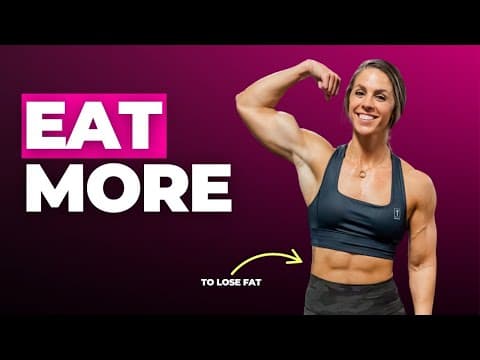
Cardio is a tool for fat loss, not a requirement. In this Sunday rally call, Nikkiey Stott explains why piling on cardio, especially long endurance sessions, while under-eating works against the muscle and toned look you want. She shares how she fuels a marathon-training client and what she sees in women who run their bodies into the ground without enough food.
Nikkiey then breaks down HIIT versus low-intensity steady-state (LISS) cardio. In her view, HIIT burns through carbohydrates and adds a lot of stress to the body, while steady state leans on fat for fuel and puts minimal stress on the body. That is why she prefers steady state for most women, particularly if you are already stressed or not eating enough. If you love HIIT, her answer is to fuel it with more carbs, not cut back on food.
She finishes with how cardio fits different body types (ectomorph, mesomorph and endomorph) and when to do it: right after lifting, fasted first thing in the morning, or as a last resort in the afternoon right before your next meal.
Key takeaways
- Treat cardio as a tool to aid fat loss, not a necessity, because you can create a deficit with the right macronutrient breakdown alone.
- If you do endurance training like marathons, long bike rides or long hikes, you need to eat a lot more food to match the calories you burn, or it becomes counterproductive to building muscle and getting toned.
- Nikkiey explains that HIIT mainly uses carbohydrates for fuel while steady-state cardio mainly uses fat, so pairing a lift with steady state lets carbs fuel the lift and fat fuel the cardio.
- If you love HIIT, make sure your macros are on point and your carbs are high enough, or you risk feeling hungry and losing muscle definition.
- If you are doing a lot of HIIT with low carbs and feel depleted and tired, swap some HIIT days for steady-state days.
- Nikkiey recommends steady state if you are under a lot of stress, since she says HIIT adds stress to the body and raises cortisol.
- By body type, ectomorphs need to eat and don't need cardio, mesomorphs do well with either (for example three steady-state days and one HIIT day), and endomorphs should stick to steady state.
- The best time for cardio in Nikkiey's view is right after lifting; otherwise do it fasted first thing in the morning, or in the afternoon right before your next meal.
Questions answered
What is the difference between HIIT and LISS cardio?
HIIT uses short bursts of high effort followed by lower-effort rest intervals, while low-intensity steady state is constant effort at a steady pace. Nikkiey explains that steady state mainly uses fat for fuel and HIIT mainly uses glycogen, or carbohydrates.
Do I need to do cardio to lose fat?
No. Nikkiey says cardio should only be a tool used to aid fat loss and is not a necessity, because you can put yourself into a deficit just by following the proper macronutrient breakdown.
Why am I losing muscle definition doing a lot of HIIT?
Nikkiey says that if you do lots of HIIT without eating enough, you burn through carbohydrates your body may not have and can tap into muscle mass and lose definition. Her fix for a client doing five days of HIIT was to give her more carbohydrates.
Is HIIT a good idea if I'm stressed?
Nikkiey doesn't recommend it if you're high stress or not eating enough. In her view, HIIT adds a lot of stress to the body, which raises cortisol, while steady state puts minimal stress on the body.
When is the best time to do steady-state cardio?
Nikkiey says the optimal time is immediately after your lift, when your carb stores are depleted. Other options are fasted first thing in the morning, or as a last resort in the afternoon right before your next meal.
Should I eat more if I'm training for a marathon?
Yes. Nikkiey describes a client training for a marathon who eats 2,300 calories, with a higher calorie range during the week and a cheat meal on long runs, so she has the energy to run.
Full transcript
Nikkiey: What's up, WarriorBabes? Hey, everybody. Nikkiey here. What's up? Welcome to our Sunday WarriorBabe Revolution rally call. It is 6 p.m. Eastern Standard Time. Super stoked to be here with you guys. I hope you guys are having an awesome day so far. I hope you guys are staying cool. It's really hot where you are. I know it's super hot in the majority of the states right now, which, let me just give you a friendly reminder, can really contribute to feeling tired and fatigued, which is something that I'm commonly hearing from a lot of babes this week. So just be aware that that could be causing the fatigue and tiredness with you guys. So make sure you're staying hydrated.
Anyway, we will get started in just a few minutes. So you guys, this is going to be a great topic. Last week I talked about macros. I usually do this heavily through mindset. So today I'm going to trickle in some workout information, some cardio information, which is going to be fire and bring a lot of value to you guys. A lot of light bulbs are probably going to go off. So go leave a comment inside the Facebook community and let the other WarriorBabes in the group know that this call is getting started and they want to hop in now. Just leave a comment. Tune in. All right?
And then before I dive into it, I want to give a huge welcome to all of the new WarriorBabes who have joined us in this past week. Our community is seriously growing. It's reaching new heights every single day. You guys who are new are a part of thousands of women who are getting toned and becoming stronger, more confident versions of themselves. WarriorBabe is where strong is the new sexy. So welcome, you guys. I'm super stoked for you to be a part of this amazing community. Super inspiring, super motivating, super supportive, which is so cool. Not something that I commonly see in the fitness world. So our community is fire, and I love it. So welcome to all the new babes.
If you guys are new, we do these calls every single Sunday at 6 p.m. Eastern Standard Time. So make sure you guys mark your calendars. Make sure you guys set your alarms. And really quick before we start, I just want to make sure that all the new babes are getting your daily emails with one task to complete in video format. And then there's a page where you can print out documents and all this kind of stuff to help you transition into this lifestyle. I call them the WarriorBabe blast-off emails. They're so important as you transition into this lifestyle, as you get used to my language, as you get used to how WarriorBabes communicate, how we thrive, how we stay motivated. Those are really important. They're coming to you for the first 14 days.
And the second thing, before I dive into this topic, is please don't be the person to ask questions that can be answered inside the application. Take the time to search there and listen through everything that I'm sharing with you. And if the question that you are seeking is not answered, then go into our Frequently Asked Questions resource page, which is an entire platform with all of our most frequently asked questions. It's something that my team is updating every single month with new articles, new questions that we get, and more in-depth answers, and you can always use that place as a resource. All right?
If your questions can't be answered in the app and they're not answered in the FAQs, then head into the Facebook community and ask your fellow WarriorBabes. And tag Kate. Kate is our community manager inside the Revolution, and she is there to help you guys with any questions that you have. She's in there every single day, and she's getting back to any questions that you guys have her tagged in. All right? So that's an area to get your questions answered.
And then, of course, attending the Q&A on Wednesdays. That's really important, you guys. Show up to the Q&As on Wednesdays and be involved. That's a really valuable tool to get the questions answered that you need clarification on. I don't know why more of you guys aren't involved in that, but it's really freaking important to get in there and get your questions answered in direct communication. You're able to see me. I'm able to answer your questions. All right? So those are really valuable resources for you guys to use here inside the WarriorBabe Revolution.
All right, babes, did you guys let the group know that this call is starting? We're going to get started pretty much right now. Are you guys ready? This is going to be a really good call. So last week, like I said, I talked about macros. This week I usually talk about mindset. But right now I want to talk about the difference between high-intensity interval training cardio versus low-intensity steady-state cardio, or I like to just call that steady state. So the difference between the two, because there's a massive difference.
And before I dive into this, you guys, I really, really, really want you to understand that cardio should only be a tool used to aid in fat loss, and it is not a necessity. I know so many of you guys are cardio bunnies or have been cardio bunnies in previous years before joining WarriorBabe, or you heavily do marathons or triathlons or you're endurance athletes. Look, I need to get my point across to you that if you are continually training with these endurance-style things like marathoning or cycling or doing three-hour bike rides or five-hour hikes, and you're neglecting your nutrition, you need to understand what too many calories out during that expenditure, biking and hiking with poor nutrition or not eating enough, is going to do to your body. It's literally counterproductive to the results that you are seeking with building muscle and getting toned.
All right, if you want to continue doing that, you love it, I'm not saying to eliminate it. I'm so all about meeting your lifestyle. But you need to understand that keeping in that amount of cardio and not eating enough is going to be detrimental to your goals. You need to either pick one, or you need to understand the importance of eating enough food when you're doing that kind of endurance. So you would be eating a shit ton of food. One of my VIP babes right now is eating 2,300 calories because she's training for a marathon. That's a lot of food, because she's running 20-mile runs. She's putting out like 2,000 calories. So to meet her demand, she gets a cheat meal on long runs, and I need her to have a higher caloric range during the week so that she has energy, she can run, she can do all this kind of stuff.
There are far too many people that I've coached who do not listen to me in this aspect. They're not eating enough food while they're doing this endurance stuff, and then they're going to the doctors and their thyroid's off, their cortisol's through the roof, and all of these hormones are out of whack. Why? Because you're running your body into the fucking ground doing all of this endurance stuff and not backing it with proper nutrition. You see, I get a little feisty with that one. It's for real, because so many women think that cardio, cardio, cardio is the tool in changing your body composition, and I need to do more cardio, and please give me more cardio, right? No. Cardio should only be a tool. Cardio is only a tool used to aid in fat loss. It is not a necessity. I just need to get my point across that if you are putting out too much and you're not eating enough, man, oh man, your body is going into a whirlwind. All right, so that's point number one.
Now let's talk about the difference between high-intensity interval training, HIIT, versus LISS, which is low-intensity steady-state cardio. There are two pointers here on the massive difference between the two. Number one, HIIT obviously involves short bursts of high effort followed by lower-effort rest intervals. Low-intensity steady state involves constant effort at a steady pace for an amount of time. Okay?
Now, this one. Low-intensity steady state forces the body to use fat as its main source of fuel for the workout. HIIT, due to its intensity, will use glycogen, aka carbohydrates, as its main source of fuel, and this source of energy is also used for your workouts. You guys use carbs for your workout. So if you are completely depleted after a lift, high-intensity training may be counterproductive, and that's why I personally recommend and like low-intensity steady state way better. Okay? Because, see, I'm trying to get my point across here: your lifting session utilizes carbohydrates. You're depleting that store. So then you basically switch gears and put your body into fat-burning mode when you do low-intensity steady-state cardio.
And you know what? I know some of you come in and say, I fucking hate cardio, 20 minutes, 30 minutes. But you know what? It's a really key tool. It really can help aid in the fat loss that you are seeking. Not a necessity, but it can aid in it because of that shift in energy, shifting gears with how the body is forced to use fat as its main source of fuel, while your lifting session uses carbohydrates. That's why I recommend low-intensity steady-state cardio. If you think about it, the body uses carbs for your workouts, then fat for your cardio. It's like a win-win. It brings about the results wanted.
So that's the difference between the two. I need you guys to fully grasp that difference. Once you grasp it, once you understand it, you're more likely to be in tune to hear me out on the next thing that I recommend, and you're more likely to follow through with the things that I personally recommend for you.
So the next question comes into play, which is: which is best for your body and your lifestyle? I'm not saying you need to mix in HIIT or you need to stop doing steady-state cardio or do either or, but understand this perspective, and it's going to blow your mind. Steady-state cardio, slow and steady, takes a longer time to finish. Yes, it's easy to do. But most importantly, it puts minimal stress on your body. High-intensity training adds a lot of stress to the body, and it is extremely hard to finish, especially if it's done correctly. But it takes a shorter amount of time to complete. So this is why a lot of people love doing it.
But let me put this into perspective. Can you imagine if somebody isn't eating enough food to fuel their body and they're doing tons of HIIT? This is why I don't personally recommend HIIT, especially if you're not keen and consistent on your macronutrient game, because you're just burning through carbohydrates that your body probably doesn't even have. And then you're going to tap into muscle mass and lose definition.
I literally just had this conversation with somebody on the Blueprint call, where she was like, I've been doing five days of HIIT and I feel great and it helps me with my stress, but I'm starving and my muscle definition is starting to lose itself. And I'm like, yeah, I bet it is, because you're doing this. And then I helped her understand. Okay, this is your major point of focus, you love doing HIIT training, so why don't we give you more carbohydrates? I'm going to give you more carbs and it's going to be more efficient. You're going to feel great. You're not going to be hungry, and you're going to be getting the results that you want.
That's why I love my Blueprint program, because it's way more personalized and I get to chat with you about the specifics of what you're going through. I can literally unmute you and discuss the questions that you have. So if you guys have any questions about the Blueprint and want to know what it is, go to WarriorBabe.com, go to the programs, click on Blueprint, and schedule a call with my team to chat about how you can follow through with the goals that you want to accomplish for yourself.
Anyway, side topic. So HIIT takes a short time to complete, but adds a lot of stress to the body. Can you guys imagine if you're already stressed throughout the day and your cortisol levels are through the roof, especially with the things that are going on in this world, you've got stressful work or a stressful home or whatever, and then you're doing this HIIT, adding more stress to your body? And when stress is elevated, cortisol rises, and cortisol is a fat-storing hormone, which just makes your body look more inflamed. Okay?
So I personally recommend low-intensity steady state. It's just healthier for your body. You're tapping into fat stores to burn off, which, if you want to decrease your body fat, should be the primary focus anyway. And you get to eat more carbohydrates. You get to fuel your body, put the carbohydrates to your lips, and carbohydrates are going to help build muscle. Whereas HIIT, I mean, you can absolutely do it, but you've got to watch it, right? It's not for you if you're high stress, and it's not for you if you're not eating enough.
All right, now let's talk about body types when it comes to cardio, because this is really important. Ectos, you guys, you skinny babes, you don't need to be doing cardio at all. You seriously do not need to be doing cardio. You need to be fucking eating. My girl Madeline is a perfect example. She's an ecto body type. She's not doing any cardio, and she's in peak week right now for stepping on stage next week. She's in the 300-carb club, reversing into her show right now, eating 300 grams of carbs and no cardio, because that body type needs to eat. They don't need to be doing any cardio at all.
Now, if we are to implement it, if ectos at some point implement it maybe one to two days a week, you guys do best with either. You can get away with doing low-intensity steady state or you can get away with doing HIIT, because if you're eating enough carbohydrates, and the majority of those women can eat a shit ton of food, you're up in the 250, 280, 300 carb club, you can be doing HIIT. All right? So that body type can really go either way, but I would personally recommend low steady-state cardio.
Mesos also work well with either low steady state or HIIT. I personally recommend, though, as an example, mesos do three days of low steady state and then maybe one day of HIIT. And then endos. This is where steady state is preferred. Due to the stress the body has already experienced with nutrition and that added weight, and cortisol already being high, that body type should 110% be doing steady-state cardio.
So then the last thing I want to talk about with you guys right now is: when should this cardio be performed? When is optimal? When should I be doing it? Really, whichever works best for you, with one rule to follow. You just want to be in a fasted state. So the best, most optimal time to do cardio is immediately following your workout, right? You've depleted your carb stores. Now you're going into fasting mode. You're on an empty stomach, basically, and your body's going to tap into fat for fuel for that steady-state cardio.
Another time to do it, if you're like, oh, I just want to get my cardio out of the way and then I can go back and do lifting later on, is to get your cardio done on an empty stomach first thing in the morning. You're on an empty stomach. You're depleted. Your body is going to turn to fat for fuel.
And the last time that I would recommend, and this is a last resort, is if, say, you lift in the morning and you can't get your cardio done at that time, then you've got to do it in the afternoon. You just want to make sure that that cardio in the afternoon is right before your next meal. So you want to make sure that you're, again, on an empty stomach, in a somewhat fasted state. Before you eat your next meal, you would go and do your 30 minutes of cardio.
All right, guys, so again, I just chatted about the difference between high-intensity interval training, HIIT cardio, and steady-state cardio. Steady state uses fat as its main source of fuel for your workout. HIIT, due to its intensity, uses carbohydrates as its main source of fuel. I personally recommend steady state because you're using carbohydrates for your lift, and then your body can switch to fat-burning mode for your steady-state cardio.
Whatever works best for your real life, though, I totally get it. If you want to get in and get it done, you can do HIIT, but just make sure that you are nutritionally on point, that your macros are on point. And if you're doing too much HIIT and your carbohydrates are low and you're feeling depleted and tired, that should be a signal for you to say, okay, I'm going to switch some HIIT days to steady-state days. Yes, steady state takes longer to finish. It's easy to do, but it puts minimal stress on the body. HIIT can add a lot of stress. I guarantee you, if you guys just make this switch, you'll see what a significant difference it makes.
And then ectos don't need cardio, but they can do fine with both. Mesos can do fine with both. And endos are really the only ones where it comes down to steady state being preferred. The best time to do cardio is after your lift. That's optimal. You can also do it in the morning, fasted on an empty stomach, or you can do it in the afternoon right before your next meal.
All right, guys, on my way out here: cardio should only be used as a tool, a tool used to aid in fat loss. It is not a necessity. You can put yourself into a fine deficit with just being on the proper macronutrient breakdown.
All right, guys, if you do want to learn more about the Blueprint, just head to WarriorBabe.com, click on products and click on the Blueprint, and it will give you a little bit more insight into what it is. So check it out. Let me know how you enjoyed this rally call in the Facebook group. Hopefully it was super helpful and light bulbs are going off. And I will chat with you guys. Remember, Wednesday at 6 o'clock Eastern Standard Time is our Q&A, so make sure you guys show up on time for that. Time change, again: 6 p.m. Eastern Standard Time on Wednesday. All right, guys, have a good start to your week. Start strong. Finish strong. You guys are WarriorBabes. No excuses. Let's go. Bye, everybody. Thank you.
Up next
Everything → 26 min
What Is Biofeedback? Signs Your Fat Loss Plan Is Off
Episode 295 · Sep 19, 2025
 6 min
How to Lose Menopause Belly in 30 Days: 3 Pillars
Video · Mar 7, 2026
 18 min
5 Fat Loss Fixes for Women Over 40: Protein, Steps, Sleep
Video · Sep 26, 2026
Best of Fat Loss After 40
All 113 → 20 min
How to Get Lean After 40: What Actually Works for Women
Episode 402 · Oct 5, 2026
 30 min
Why Eating Less Isn't Helping You Lose Fat After 40
Episode 390 · Aug 24, 2026
 27 min
Why Eating More Helps You Lose Fat After 40
Episode 272 · Jun 30, 2025