

From 4 episodes
Why am I not building muscle even though I work out?
Answered by Nikkiey Stott · Updated
The short answer
Most often, your training isn't challenging your muscles enough or your eating isn't fueling them. Nikkiey points to switching workouts constantly, going through the motions without adding weight or intensity, and under-eating, plus poor sleep, stress and recovery. Her fix: run one program for six to eight weeks and make the last three reps of every set hard.
Hear it answered
Tap play to start right where it's answered. It keeps playing while you browse.
Nikkiey's five reasons muscles don't grow, starting with ineffective training
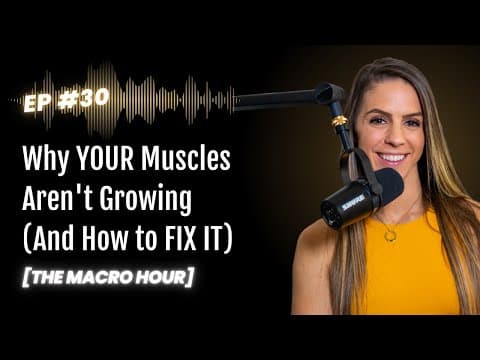
Plays from 0:48 · Ep. 30: Why Aren't My Muscles Growing? 5 Fixes for Women
Why program-hopping and going through the motions stall your muscle gains
Plays from 5:41 · Ep. 53: How to Use Progressive Overload to Build Muscle
Andrea Simulis on under-eating, endless cardio and training in phases
Plays from 18:43 · Ep. 217: How a Busy Mom of 4 Built Muscle and Got Lean With Macros
Nikkiey on why lifting fasted works against building muscle
Plays from 2:48 · Ep. 116: How to Build Muscle After 40: What Actually Works
The full answer
Showing up isn't the same as giving your muscles a reason to grow. On Ep. 53 and Ep. 116, Nikkiey explains that if you do something different every day, train inconsistently, or never add weight or intensity, your muscles may stop adapting. You could spend six months or a year wondering why you aren't stronger. Her rule from Ep. 30 is that the last three reps of each set should be hard. You're making ugly faces and the bar is tough to move, but your form holds. If those reps feel easy, increase the weight. She admits that repeating the same program for six to eight weeks is boring. That repetition is how progress happens.
The second half is food. On Ep. 116, Nikkiey describes muscle as active tissue that gets its energy from food. She says lifting first thing in the morning without eating, including while doing intermittent fasting, puts you in a catabolic state that works against your goals, and she recommends fueling before and after workouts and throughout the day. On Ep. 30 she says building muscle takes a surplus of calories and nutrients, especially protein. On Ep. 217, coach Andrea Simulis describes a pattern she sees in many women over 40. They eat too little, lift hard, do a lot of cardio, then wonder why they never look toned. Her approach is to work in phases, for example a 12-week fat loss phase followed by a phase focused on building muscle, rather than trying to do everything at once.
On Ep. 30, Nikkiey adds sleep, chronic stress and recovery to the list. Her suggestion is to check yourself honestly in each area and fix whichever one is falling short. Consistency matters more than intensity bursts. She says a steady hour of training repeated over weeks beats going all out for three hours at the start and burning out.
From WarriorBabe's coaches (how we write our answers). For education, not medical advice: talk to your doctor about your own health.
Women also ask
More on Building Muscle After 40 →
Building Muscle After 40
How do I go from a building phase into a fat loss phase?
Nikkiey says to lower calories slowly rather than all at once, and to keep protein the same or nudge it up so you protect the muscle you just built. Track progress with photos instead of the scale. Expect your strength to dip a little, and expect some hunger. A small protein increase often helps.
Read the answer →
Building Muscle After 40
Do muscles grow during the workout or during rest?
Muscles grow during rest, not during the workout. Nikkiey explains that lifting creates tiny tears in your muscle fibers, which signal your body to repair and rebuild. That rebuilding, called muscle protein synthesis, happens in the hours afterward, fueled by enough food, sleep, hydration and recovery. The gym starts the process. Recovery finishes it.
Read the answer →

Building Muscle After 40
Can I build muscle in a calorie deficit?
Yes, you can build some muscle in a calorie deficit, especially if you're newer to strength training or have more fat to lose, but not as much as at maintenance or in a surplus. Nikkiey explains that a modest deficit, enough protein and a real lifting program work. Crash-level calories like 1,200 don't.
Read the answer →
Building Muscle After 40
How long does body recomposition take after 40?
One WarriorBabe coach frames body recomposition after 40 as a rebuild of six to 12 to 18 months, not a 30-day challenge. You usually feel changes in weeks one to four, see them in months two to three, and by month six the change is undeniable. Client stories on the show took one and a half to two and a half years.
Read the answer →

Building Muscle After 40
How many sets per muscle group per week do I need to build muscle?
Nikkiey cites research showing 10 to 20 sets per muscle group per week produces optimal muscle growth for most people. Training three to four times a week, that works out to roughly three to six working sets per muscle group per session, which fits in a focused 45- to 60-minute workout. You don't need two-hour sessions.
Read the answer →
Building Muscle After 40
Why does the scale go up during a muscle-building phase?
The scale goes up during a muscle-building phase because you're eating more food, and food has weight. The extra carbs are stored as glycogen, which holds about three to four grams of water per gram. You're also adding muscle, and Nikkiey says a small amount of fat comes with it. That is normal and expected.
Read the answer →
Watch or listen in full
More on this topic → 19 min
How to Use Progressive Overload to Build Muscle
Episode 53 · May 10, 2023
 22 min
Why Aren't My Muscles Growing? 5 Fixes for Women
Episode 30 · Mar 17, 2023
 42 min
How a Busy Mom of 4 Built Muscle and Got Lean With Macros
With Andrea Simulis