

Chapters
In this video
If you do well for a while and then find yourself back in the pantry at night, this video is for you. Nikkiey Stott shares five strategies for getting control of impulse eating. She admits she is still obsessed with sweets and candy. The difference now is impulse control and the mental discipline not to act on every urge.
The strategies are simple. Identify the triggers that lead you to eat. Plan your meals and snacks ahead of time. Pause and ask whether you're actually hungry. Find other ways to cope with stress and boredom. Keep the foods that control you out of the house for now. Nikkiey's advice is to start with just one, practise it for two or three weeks until it's a habit, then stack the next one on top.
She also shares how she still has two or three pieces of chocolate almost every night without losing control. She plans them into her macros ahead of time, which keeps her from wanting the whole bag. When you slip, give yourself grace and get back on track the next day.
Key takeaways
- Identify the triggers behind your impulse eating, such as stress, boredom or snacking at night in front of Netflix, so you can build a plan to manage them.
- Replace the trigger with something else: go for a walk to work out stress, or brush your teeth at night when you're bored, since Nikkiey won't eat after brushing.
- Plan your day of eating ahead of time, including packed snacks or a protein bar, so you aren't starving four hours in and grabbing whatever is nearby.
- When the urge hits, pause and ask whether you're really hungry or bored. If you've already eaten what you planned, drink a lot of water and check in again 10 minutes later.
- Cope with negative emotions in other ways that support you, such as a walk, a workout or a call with a friend.
- Keep foods that have control over you out of sight or out of the house for now, and fill your grocery cart with fruit, vegetables, whole grains and protein.
- Start with one strategy, practise it daily for two or three weeks to build the habit, then stack the next one. Trying all five at once is a recipe for failure.
- Plan a small treat into your macros, like Nikkiey's two or three pieces of chocolate each night, so you can satisfy a sweet tooth without eating the whole bag.
Questions answered
What should I do when I want to snack at night even though I've eaten enough?
Nikkiey suggests pausing to ask whether you're really hungry or just bored. If you've already eaten what you planned for the day, drink a lot of water and ask yourself again 10 minutes later. Brushing your teeth can also help stop late-night snacking.
How does planning ahead help with binge eating?
When your meals and snacks are already planned, as with tracking macros, you have a conscious interruption against grabbing something unplanned. Packing snacks or a protein bar means you won't be starving and reach for something that isn't good for you.
Is keeping junk food out of the house just restriction?
Nikkiey says no. If a food has control over you right now, it doesn't serve you, so remove it until you've gained control over it.
Can I still eat sweets and stop binge eating?
Yes. Nikkiey plans two or three pieces of chocolate into her macros almost every night. She says allowing herself that small amount keeps her from wanting to eat the whole bag.
Should I try all five strategies at once?
No. Nikkiey calls that a recipe for failure. Pick one, apply it daily for two or three weeks to build the habit, then add another.
Full transcript
Nikkiey: Today, I'm going to share with you guys five strategies to help with impulse eating. Your goal may be to get into shape, maybe to lose fat, maybe to feel better about yourself. And one of the biggest ways that you're going to do that is by learning to be in control of yourself around food. So maybe you're struggling with this. Maybe you've struggled with it. Maybe you do really well for X amount of time and then you fall off. All of a sudden you find yourself falling back into old habits, and you just don't have a grip on how to control yourself around food and how to manage your impulses.
Impulse control is a big part of how you're going to do that, and this is what we're going to talk about today. Let me remind you guys too that I've been in your shoes with this. And if I can learn how to control it, so can you. Prior to my journey, I was obsessed with sweets and candy. I mean, shit, I still am, truthfully. I just have better impulse control and the mental discipline to stop me from following through on the impulse.
Let me tell you this too. It will take you time, practice and dedication to your goals. So don't get mad at yourself if one time you mess up. Don't beat yourself up. Don't tell yourself you suck. Don't tell yourself that you're a failure, because that narrative in your head, you're going to start to believe it. You're going to stay stuck in that low energy and that low vibe, letting the impulses control you rather than you controlling the impulses. So when you do mess up, and it will happen, give yourself grace. Get back on track the next day. Don't let it spiral. You have the control of going about the day how you want to. Failure or mistakes are all a part of your journey. So just remember that.
All right, let's dive into these five strategies to help with impulse eating. Number one, and this is probably the most important one, and it's also one of the hardest: be aware of and identify the triggers that lead to the impulse eating. Maybe you're somebody that eats when you're stressed or when you're bored. An example is at nighttime. You're at the end of the day, you're tired, you're just chilling out, and you find yourself in the kitchen, in the pantry, snacking on things. Or you're watching Netflix and snacking on things that just aren't good.
So identify these triggers that lead to the impulse. By identifying the triggers, you can start to develop strategies to manage them. For example, if you snack when you're stressed, you might start to find alternative ways to manage that stress instead of eating. But you have to be aware of this. When you're in the kitchen snacking, it's like, whoa, here I am in the kitchen. I'm going to get to this in a second with another strategy, but it's bringing awareness to the action that you're about to take.
Then you may start to find alternative ways to cope with that stress or that boredom. For example, with stress, it's like, okay, here I am. I'm identifying the trigger that's leading me to impulse eat, or to want to impulse eat right now. Instead of going to eat because I'm stressed, I'm going to go on a walk and walk out my stress. Or this is a really good one that I used to do: when you're bored at night, instead of going to eat, go brush your teeth. Because I personally will never eat anything after I brush my teeth. That just bothers me.
The second strategy is plan ahead. Another way to reduce impulse eating is to plan ahead and have healthy snacks and meals ready when you need them. This is why I love tracking macros so, so, so much. I plan my days ahead of time, so my whole day is planned and I have control of what I'm going to be eating the next day. And I'm going to share a little secret with you guys towards the end of this: how I still incorporate treats and candy almost every single night.
Anyway, my healthy meals are already planned. So it's a conscious interruption of, oh, I could go get a burger or a bad lunch with my co-worker Linda. It's like, no, I'm already planning my meals for today. I'm not going to go do that, because I have my meals planned ahead of time and I'm going to stick with it. This can help reduce the temptation to make unhealthy food choices. Don't be tempted by Linda.
So consider packing healthy snacks to take with you when you're on the go, or preparing healthy meals in advance so you have something to grab when you're short on time, or when you have bad-influence co-workers like Linda. Another perfect example: instead of being like, oh, I need to run to Wawa, which is a gas station, no, I'm actually going to plan, stick to my meals and prepare everything in advance so that I have something to grab when I'm on the go. Or a protein bar. I love Condition One protein bars. They're so freaking good. It's a great thing to grab instead of being like, oh my God, I'm four hours in, I haven't eaten, I'm starving, and then you resort to something that's not healthy for you to get that fix.
The third one I touched on when we were talking about number one, identifying the triggers, and that is practicing mindfulness. When you feel the urge to eat impulsively, take a moment to pause and ask yourself why you want to eat like this. Are you really hungry, or is something else going on? I used the example of pausing in the moment when you're walking into the kitchen looking for food at night. You have to learn how to control yourself around food.
Here I am in the kitchen at night watching Netflix. I'm bored. I just had a really long, stressful day. And you find yourself in a bag of Doritos. Well, pause. Ask yourself, why do you want to eat this? Are you really hungry, or are you bored? More likely than not, you're bored. And if you are really hungry but you've already eaten what you're supposed to eat for the day, just chug a bunch of water. Then 10 minutes later, ask yourself, are you really hungry? Or was it truly something you were feeling emotionally?
Practicing mindfulness can help you become more aware of your eating habits and make more intentional choices moving forward. It can also help you recognize when you're eating for emotional reasons, like I just spoke to, rather than actual physical hunger. You could just be thirsty, and you down water and 10 minutes later you're like, oh, that was totally an emotional trigger. You start to learn why you were feeling hunger. Practicing mindfulness can be an absolute game changer, second to identifying the triggers that lead to impulse eating.
So it's like, here I am in the moment. Why do I want to eat? Am I stressed? Is it an emotional reason? Or am I actually physically hungry? Great questions to ask yourself, you guys. Always be asking yourself questions like that, because you're going to get answers right away. And then it's up to you to control the way that you act after that.
Number four is find alternative ways to cope with negative emotions. The majority of the world turns to food to cope with negative emotions, but we know this can lead to unhealthy habits and unhealthy eating patterns. We want to break that. That's why we're here. That's why I'm here talking about this right now. So instead of turning to food to cope with negative emotions, try finding other ways to manage your feelings.
I spoke to this earlier. It's like, okay, here I am emotionally wanting to eat. I'm triggered. I'm stressed and wanting to eat. Maybe I can take the stress and go for a walk. Or I can go work out. Or I can phone a friend and talk to them. Or I can brush my teeth. How can I replace this with something else that's supportive? How can I release a negative emotion through a walk or a workout and not turn to food to cope with it?
And then the last one, which I love, and this is what we always speak to inside of WarriorBabe at first when we're coaching women: keep unhealthy foods out of reach, out of sight, out of mind. It's so true. If you have a hard time resisting certain unhealthy snacks, try to keep them out of sight or out of the house altogether. You're not restricting yourself with that thought process. You know this does not serve you in the moment, because it has control over you right now. You don't have control over it. So until you get control over it, you have to just eliminate it altogether for now.
So at the end of the night, when you're bored and watching Netflix, you're going to be like, oh, nothing's here for me to eat, so I can't eat it. You know what I mean? This might also help you to consider replacing unhealthy snacks with healthier options. When you go grocery shopping, it's like, I want fruit, vegetables, whole grains, protein. I want this in my house, not this other junk. As you become more aware of this, guys, and you do these things, it's going to help you so much.
So those are the five strategies to help with impulse eating. If you start by breaking down just one of them and applying it daily, then add others as you feel your confidence growing, it's going to be a total game changer. It doesn't have to be, oh, I'm going to apply all five of these strategies at once. No, that's a complete recipe for failure. It's like, let me take one, break it down, apply it for two or three weeks and build a habit on it. Then I can add in another one and start habit stacking all of these.
Literally, you guys, if you do this, and I ask that you do, and you take this action, you will drastically see a difference with impulse eating, if that's something you are struggling with, within the next two or three months. If you do this and apply it, I promise you.
So I'm going to close out the video today with this. Remember that it's okay to indulge in treats occasionally, but it's important to have a healthy relationship with food overall. You have to control your impulses and you have to control food. You can't let the impulses and food control you. And like I already spoke to earlier, that's why I love tracking macros so, so, so much. Macros to me aren't another diet. It's literally a skill set that can serve you for the rest of your life.
I told you earlier I was going to share this with you guys. When I plan ahead, I always incorporate two or three pieces of Dove chocolate every single night at the end of my night, because I'm able to fit them into my macros. That's enough for me to curb my cravings for candy. I have an insane sweet tooth, yet I'm still able to be in alignment with my goals. Allowing yourself this keeps you from wanting to eat the whole damn bag. That's the skill set and the mental discipline that come with tracking macros.
All right, you guys, those are the five strategies to help you with impulse eating. I truly, truly hope that this video has helped you and served you in some way, and that you can turn this into actionable takeaways and apply it in your everyday life. That can lead you to the ultimate goal I just spoke to: having a healthy relationship with food overall and learning to control yourself around food. If this has served you and helped you in any way, please share this and subscribe to our channel. I'll see you guys next time.
Up next
Everything →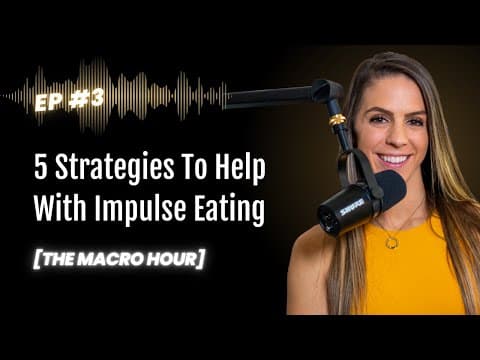 17 min
How to Stop Impulse Eating: 5 Strategies That Work
Episode 3 · Jan 9, 2023
 16 min
How to Break Bad Eating Habits Using the Habit Loop
Video · Nov 2, 2020
 26 min
Is Tracking Macros Too Restrictive for Women Over 40?
Episode 80 · Jul 21, 2023
Best of Food Noise, Cravings & Overeating
All 49 → 28 min
Why Can't I Stop Thinking About Food? Food Noise After 40
Episode 376 · Jul 6, 2026
 50 min
How to Stop Food Cravings Without Restrictive Dieting
With Abbey Sharp
 19 min
Why Am I Always Hungry? How to Fix Constant Hunger
Episode 262 · May 26, 2025